Friday, 31 January 2014

Spilt Milk by Amanda Hodgkinson


Reviewer : Gillian Hamer, author of The Charter  (www.gillianhamer.com)

What we thought : "Their eyes were the colour of the river. Grey as rain-swilled waters. It was how you knew the three of them were related. Nellie, Vivian and Rose Marsh." 

From the opening line of this novel, the scene is set. The importance of the river, the importance of the characters, and the importance of relationships. It also lays the first hint that not all may be as it seems within this family story.

Spilt Milk is the story of sisterhood and motherhood through the generations of a single family. Starting in 1913 with three sisters living an idyllic life in a cottage near a river in rural Suffolk. As the two youngest, Nellie and Vivian, blossom, their innocent existence is blown apart when a stranger, Joe Feriers, arrives in town. Both Nellie and Vivian fall for Joe and the consequences are devastating, creating a secret the sisters will be forced to carry to their graves, overshadowing everything else life presents them.

We follow Vivian and Nellie’s life stories right through into the 1960s. From their unusual start in life, they do go on to marry and create lives of their own, apart from one another – a fact that would have shocked the women at the outset. The author manages to convey wonderfully that not only do the sins of the father (or mother) echo on through time, but that generations of the same family can often inexplicably face similar life events, and it is interesting to see how each generation deals differently with them as time rolls on.

I thought Amanda’s first novel, 22 Britannia Road, was beautifully written and have eagerly awaited her second. And it doesn’t disappoint. There’s even more of a lyrical quality to Amanda’s writing here, which works perfectly, some scenes are so intense they are almost cinematic. The setting is perfectly described and the sense of time, as we move through the war years and onwards, is breathtakingly detailed and accurate. You feel as if you have stepped right into the character’s shoes and are seeing the world just as they knew it – whether it be the grime and danger of war-ravaged London or the open spaces and simple beauty of rural Suffolk. At the same time, while time moves on, you have a sense the author really wants to bring home the message that age is just a number, a date is just a reference, and that nothing really changes. 
I was captivated by the story of the generations of this family and the shadows they carried, and I'm sure you will be too.

You’ll enjoy this if you like : Stories of families, secrets and lies.


Avoid if you don’t like : Beautiful writing!

Ideal accompaniments : Strawberries and cream and a bottle of pear cider.

Genre : Literary fiction


The Jewish Messiah by Arnon Grunberg (translated from Dutch by Sam Garrett)

What We Thought: 

Reviewer: JJ Marsh, author of The Beatrice Stubbs series


Growing up in Basel, Xavier Radek feels a calling, so undertakes to comfort the Jews. He decides to convert to Judaism, learn Yiddish and get circumcised. Awromele, the local rabbi’s son agrees to help him. The Yiddish goes well, the circumcision less so. Mr Schwartz, a cheese importer with failing eyesight, botches the operation and Xavier loses a testicle.

With his unattached testicle (christened King David) in a jar, and thinking only of Awromele, Xavier returns home. But his mother’s new boyfriend thinks only of Xavier, so she embarks on a new sexual adventure. With a kitchen knife.

Awromele and Xavier’s relationship grows, on the condition that neither allows himself to feel anything. Their new project is translating Mein Kampf into Yiddish. "It's a fascinating book," Awromele said. "It's got pace, it's got momentum, it's full of humour, and I think the writer has a good story to tell. We've struck gold."

Such an audacious premise takes true skill to balance prejudice, religious sensitivity, and historical memory with gorgeously crafted writing, character and pace. The former Grunberg handles perfectly. The themes provoke consideration, and many set pieces make you laugh aloud while wincing in pain. And all the while, you’re checking over your shoulder for the political correctness police.

It is a satirical farce, written with an acidic intelligence which rejects kid gloves, taking on subjects most writers would not touch with rubber ones. Grunberg is an astounding writer, but his best may be yet to come.

You’ll enjoy this if you like: pitch-black comedy, Ned Beauman, transgressing taboos

Avoid if you dislike: irreverence towards religion/history, gay romance, the grotesque

Ideal accompaniments: Pickles, sloe gin and Kurt Weill

Genre: Contemporary, literary fiction

Accabadora by Michela Murgia (translated by Silvester Mazzarella)

What We Thought:

Reviewer: JJ Marsh, author of The Beatrice Stubbs series

Beautiful, magical, with a subtle evocation of island culture in a period gone by.

For a mother with too many daughters, it's a neat solution to make a bargain with a sterile woman. A better life for the girl and for the lonely woman.
So Maria is a fill'e anima - a soul child.
Bonaria is the accabadora, the opposite to a midwife. She assists souls on their way out.

Maria and Bonaria Urrai grow to understand each other and their place in the unspoken culture of Sardinia in the 1950s.
The rural landscape and way of life is traditional, charming and brutal. The story of growing awareness and a broadening perspective is not restricted to Maria. The reader learns much, absorbed by the atmosphere of this complicit, tight community, about how right and wrong are dependent on the eye of the beholder.

It's a delightful book, characterised by evocative images and subtle personalities. And Murcia's writing is enough to make you stop and catch your breath. Maria is six years old and making a mud tart full of live ants, decorated with sand and wild flowers.
"Under the fierce July sun Maria's pudding grew in her hands with the beauty that sometimes characterises evil things."
And that's on page one.
Hats off to the translator, because this book is a thing of beauty.


You’ll enjoy this is you like: JM Synge, Watership Down, Jean de Florette/Manon des Sources

Avoid if: your perception of southern Italy is directed by Francis Ford Coppola

Ideal accompaniments: Limoncello, chiacchiere (angel wings) and a classic tarantella, ideally by Schubert.

Genre: Literary fiction, historical


Remarkable Creatures by Tracy Chevalier

http://www.tchevalier.com/remarkablecreatures/story/
What We Thought:

Reviewer: JJ Marsh, author of The Beatrice Stubbs series

Chevalier has a real talent for painting women (no pun intended). This novel, with absorbing themes of science, the legacy of nature and the meaning of discovery is the story of two extraordinary women. It is based on real people and events. Working-class fossil hunter Mary Anning has an expertise and an eye to envy. Elizabeth Philpot, one of the middle-class spinster sisters, finds a like mind in Mary, as they seek to uncover the wealth of treasures buried in the rocks of Lyme Regis. Their talents attract attention, and not only of scientific interest.

I don’t know how Tracy Chevalier does it, but in a few pages, you are entirely transported to a wet, windswept beach in the early 1800s, held rapt by her gift for storytelling. The mood, the ambience of the age, the environment and the tension between the characters all spring to life with a few deft touches.

Along the way, the reader picks up a great deal about the gender imbalance of the period, the class system, the detail of fossil collecting and importance of reputation.

This book is one to savour and appreciate in small chunks, to absorb yourself in the world and remember that these creatures were not only remarkable, they were real.

You’ll enjoy this if you like: Kate Summerscale, Sarah Waters, Peter Ho Davies

Avoid if you’re looking for: a bodice-ripping, rollicking saucy seaside romp

Ideal accompaniments: dry Sauvignon Blanc, a punnet of whelks and Benjamin Britten’s Cello Suite No. 1

Genre: Historical fiction

The Teleportation Accident by Ned Beauman


What We Thought:

Reviewer: JJ Marsh, author of The Beatrice Stubbs series

Epic, intelligent, hilarious, poignant in its perversity, The Teleportation Accident shows that Boxer, Beetle was certainly no one-off success. Ned Beauman’s soaring imagination is an eclectic cultural mugger with a swooping intellect and virtuoso wit. I could fill this entire review with quotes from the book: extended metaphors which become riffs for a solo instrument, unforgettable graphic similies and a daring smash-and-grab attitude to language, literary convention and likeable characters.

Humour, dark and mischevious, permeates the entire novel. If you relinquish control and throw yourself into this wild and unpredictable tale, you’ll have one hell of an adventure. Beauman’s writing sits at that wonderful juncture between rollicking, rebellious, unfettered imagination and mature references from a well-educated mind. His almost teenage glee at punning names is juxtaposed with the references to cultural off-stage personae such as Brecht, Lovecraft and Sartre culminate in a breathlessly exciting bobsleigh run through the previous century.

Read this for the rich and convoluted descriptions, superb counterpoint to social European history and its kaleidoscopic contradiction of Rackenham’s assertion. “English fiction is dead.”

You’ll enjoy this if you like
: David Foster Wallace, Monty Python, Mikhail Bulgakov

Avoid if you dislike: Genre-bending, drugs and alternative approaches to history

Ideal accompaniments: Champagne cocktails, bratwurst with sweet mustard, and Phil Spector’s back catalogue

Genre: Contemporary fiction, literary fiction

The Goldfinch by Donna Tartt


Reviewer : Gillian Hamer, author of The Charter (www.gillianhamer.com)
The Baileys Prize Shortlist

What we thought : One of those books that you so don't want to finish!
As I grow older, I find I increasingly yearn for flawed characters, those who have so many layers that as you unpeel them, you go from shocked to emotive to repulsed and back again. Here, we are spoiled. We have Theo Decker, who to say is troubled is the biggest understatement of the year. We have Boris, whose life story was so complex he'd lost sight of his moral compass at birth. We have darkly secretive art dealers, darkly secretive women, and the adorable Hobie. And I loved them all.

This is an epic novel, ten years in the making, and you can see how the layers have been honed, polished and perfected over time. This is a how-to example of perfection in literary fiction for me. The depth and attention to detail, the perfect characterisation and the rambling narrative and dialogue that suits every scene to perfection. Even the accents! Boris was sublime.

Theo Decker must have been a wonderful character to create. Left alone after the loss of his mother at a young age in the most dramatic of circumstances. Passed into the guardian-ship of the Barbour family whose imprint lasted right through his turbulent years in Vegas with his father. A relationship with Boris that fell under no distinct category. His return to Hobie whose paths crossed via a life changing moment. Bound by layers of guilt that he carries for life and almost lead to his destruction. I could almost weep I didn't have chance to create and live this life with him.

Without doubt, this is a lesson in excellent writing, and one that will stay with me for a long, long time.

You’ll enjoy this if you like : Donna Tartt (I don’t honestly have a comparison).

Avoid if you don’t like :  Vegas, New York, Amsterdam. And art.

Ideal accompaniments : A tea-total mint infusion (you will never want to touch alcohol again) and a detox smoothie.

Genre : Contemporary, literary fiction

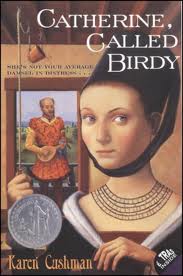
Catherine Called Birdy by Karen Cushman

cover art

Reviewer: Liza Perrat, author of Spirit of Lost Angels and Wolfsangel (www.lizaperrat.com)

What we thought: Amusing and thought-provoking. Set in 1290, Catherine Called Birdy is told through 14-year old Catherine’s quirky diary entries. The daughter of a minor nobleman, Catherine would prefer to play outdoors with the wild peasants, rather than pursuing the usual occupations of a noble girl, such as embroidering and sewing. In fact, she truly wishes she’d been born a boy. But Catherine is approaching the age of marriage, and her hateful father invites one suitor after another, all of whom the girl finds repulsive. She wants none of this marriage lark, and makes a game of turning away each potential husband. That is, until she meets her match – the ugliest of all the men – who seems determined to make Catherine his wife. Catherine’s life is starkly different from that of a modern child, though her reactions are spookily familiar.

You’ll enjoy this if you like: Books for age 9 upwards, Beowulf, Robin Hood & his Merry Men.

Avoid if you don’t like: Medieval tales, arranged marriage, horrible fathers.

Ideal accompaniments:
A mug of ale with a trencher of heron roasted with pepper and cloves.

Genre: Historical Fiction