Genres
Wednesday, 27 April 2022
Keeping the House by Tice Cin
Reviewer: Catriona Troth
What We Thought of It:
When Damla’s father is sent to prison, her mother, Ayla, must navigate her way around north London’s Turkish Cypriot drugs trade to make one last deal to keep a roof over her familys heads.
Ayla, far from the helpless little woman the drugs gang initially takes her for, masterminds a slow-burning plan to plant packets of heroin within the hearts of cabbages as they grow, and then smuggle them inside the full-grown vegetables.
What follows, however, is far from a typical crime thriller. The story of the drugs trade is smuggled inside a much larger narrative. Told from the points of view of three generations of Cypriots around the Broadwater Farm estate in Tottenham, it’s an intimate, sometimes funny, sometimes tragic portrait of an immigrant community. It moves backwards and forwards in time between 1999 and 2012, splintering between different perspectives, as if we are peeking in through different windows, catching glimpses of stories that we must stitch together to form the whole.
Damla is having her own (mis)adventures with Cemile, the younger sister of Feliz – a girl so wild she takes the heat off the two younger girls and lets them get away with more than they should. The two are what Cin describes as “under-the-kitchen-table kids” – vaguely neglected; disconnected from their communities without quite knowing why, tumbling into experiences they are not really mature enough to handle.
Tice Cin is poet and digital artist as well as an author. Her prose periodically elides into poetry. Her language is lush: the sounds of it, and the images is conjures, all carefully considered.
Like so many immigrant stories, much revolves around food. Not only the traditional Turkish dishes cooked by Damla’s grandmother (“the meals that slid oil into you, that kept you full when you wanted to eat more but couldn’t.”) but the sticky Panda pop and barbecued ribs Damla buys for her little brother – the foods of their adopted home in north London.
Shortlisted for the 2022 Jhalak Prize.
You’ll Enjoy This If You Loved: You People by Nikita Lalwani, A Cupboard Full of Coats by Yvvette Edwards
Avoid If You Dislike: Fragmented narratives. Stories centred around drug dealing.
Perfect Accompaniment: Helva (tahini-based fudge-like sweet)
Genre: Crime. Literary.
Buy This Book Here
Things We Do Not Tell the People We Love by Huma Qureshi
Reviewer: Catriona Troth
What We Thought of It:
Huma Qureshi’s Things We Do Not Tell the People We Love is a collection of stories about the fractures that run through relationships. Between mothers and daughters. Husbands and wives. Friends and mis-matched lovers.
There is the supressed memory of a sexual assault, buried so deep it has never seemed important enough to tell the man she loves. We meet a daughter who, heartbroken at the death of her father, attempts to poison her mother. Another who pushes her mother from the balcony of a hotel bedroom. A mixed-race engaged couple break apart over a failure to see each other’s point of view. A wife in an arranged marriage slides into post-partum depression with a husband with whom she cannot connect. Another folds paper cranes as she recovers from her third miscarriage.
Listing the themes makes this collection sound dark, even grim. Yet something about it nonetheless feels like soul-food. Life-affirming.
Qureshi’s language is often lyrical, conjuring beauty even when her mood is dark. “In the afternoons, lazy white clouds rolled through the sky like long cats, casting a thin shade between dissolving to let the sun stretch into the evenings again.” In another story, loose stars roll like spare change across the city sky. There is a recurring image of floating paper – not just the origami cranes, but butterflies floating like bits of ripped paper in the breeze, petals of bougainvillea scattering like paper hearts falling in slow motion.
Longlisted for the 2022 Jhalak Prize, this is a collection of stories that would bear reading and re-reading.
You’ll Enjoy This If You Loved: Subjunctive Moods by C G Menon; Love Across A Broken Map by The Whole Kahani
Avoid If You Dislike: Stories about the things that break relationships
Perfect Accompaniment: Folding an origami paper crane
Genre: Short stories. Literary
Buy This Book Here
Friday, 11 March 2022
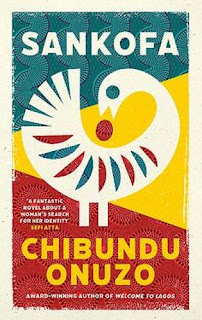
Sankofa by Chibundu Onuzo
Reviewer: Catriona Troth
What We Thought of It:
“You came to meet a man in the past. There is a mythical bird we have here, Anna. We call it Sankofa. It flies forward with its head facing backwards. It’s a poetic image, but it cannot work in real life.”
Clearing out the
house after the death of her mother, Anna comes across a notebook written by the
father she never knew. Written when he was a young African student on the fringes
of radical politics, it reveals a story she was never told – of how her parents
met. Yet it ends abruptly, without explanation as to why he left and never came
back.
With these clues to
go on, she begins to research his name, and discovers to her shock that her
father became the first President of Bamana, the country of his birth. And that
his legacy is anything but straightforward.
She first tracks
down the British academic who wrote his biography and then, with great trepidation,
travels to Bamana to confront her father and learn something about her own
identity. But Anna finds herself an obroni (foreigner) in Bamana, out of
her depth, pulled in different directions, judging the country – and her father
– with European eyes.
Initially
suspicious, her father – still a powerful and wealthy man – makes her a Bamanan
citizen and then takes her to his country home, an estate where he wields enormous
power and where they call him Daasebre: “we cannot thank you enough”.
But other members of
the family are less than happy at the appearance of this previously unknown
eldest daughter from England. And when Anna begins to challenge some of her
father’s actions, things get complicated. Is there a way for Anna to find a
reconciliation between the two parts of herself?
Sankofa is an exploration
of how identity impacts those of African heritage, of the complicated
relationship between Europe and Africa and how it affects them, their values
and their sense of self. Onuzo, like Anna, challenges both European and African
standards and assumptions.
You’ll Enjoy This If
You Loved: When We Speak of Nothing by Olumide Poloola; Admiring Silence by
Abdulrazak Gurnah; The Private Joys of Nnenna Maloney by Okechukwu Nzelu; Brit(ish)
by Afua Hirsch
Avoid If You
Dislike: Fictionalised versions of Africa
Perfect
Accompaniment: A bottle of ice cold water and a sketchpad and paints
Genre: Contemporary,
Literary
Thursday, 10 March 2022
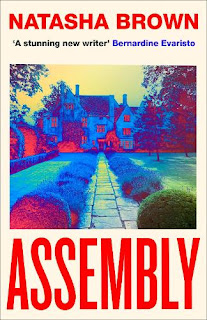
Assembly by Natasha Brown
Reviewer: Catriona Troth
What We Thought of It:
The protagonist of Natasha Brown’s Assembly is, to all outward appearances, a success story. Despite her background, despite the colour of her skin, she has ‘made it’. She has a good degree from a prestigious university, a well-paid high-flying job, a relationship with the kind of man who gives her entrée into British society. She is invited to give talks to young women in schools, to inspire them:
The diversity must be seen. How many young woman and girls have I lied to? How many have seen my grinning face advocating for this or that firm, or this industry, or that university, this life?
But what no one else knows is that she has just received a cancer diagnosis. A cancer that will, without treatment, inevitably kill her. A treatment that she has decided to refuse.
Through the weave of the narrative, the cancer becomes a metaphor for racism, her refusal of treatment a refusal of complicity. A refusal to accept ‘diversity’ and ‘tokenism’ as a sticking plaster in place of rooting out racism and inequality.
Surviving makes me a participant in their narrative. Succeed or fail, my existence only reinforces this construct. I reject it. I reject these options. I reject this life. Yes, I understand the pain. The pain is transformational – transcendent – the undoing of construction. A return, mercifully, to dust.
Brown takes aim at the smug liberality that congratulates itself for the success of a few Black faces while at the same time:
We have seen now, just as then, the readiness of this government and its enterprising Home Secretary to destroy paper, our records and proof. What is citizenship when you’ve watched screaming Go home vans crawl your street? […] When British, reduced to paper, is swept aside and trodden over?
Assembly is short, slim even for a novella. But Brown’s excoriating prose punches well above its slender weight.
You’ll Enjoy This If You Loved: Exquisite Cadavers by Meena Kandasamy; That Reminds Me by Derek Owusu;
Avoid If You Dislike: Fragmented narratives
Perfect Accompaniment: Tea and toast
Genre: Literary Fiction
Buy This Book Here
Tuesday, 8 March 2022
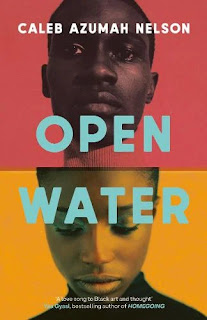
Open Water by Caleb Azumah Nelson
Reviewer: Catriona Troth
What We Thought of It:
Open Water is an astonishing love story – delicate, tender, sensual, intimate.
It is written in the second person – an unknown narrator addressing the male protagonist, a young Black man, throughout as ‘you’. Whoever this narrator is, they are privy to the man’s deepest and most private thoughts and emotions. As readers, we find ourselves at once deep inside the protagonist’s head, and yet at one critical remove from it – a clever, challenging and at times unsettling balancing act.
The man meets the women he falls in love with at a party, when she is still in a relationship with a friend of his. He is a photographer, she a dancer. The connection is immediate and intense, and though neither of them makes a move to act upon it, the electricity between them is enough to fracture her previous relationship.
For a long time, they remain as intimate friends, though the direction of travel of their relationship feels inevitable. Nelson’s descriptions of the slow graceful process of surrendering to love are exquisite:
You’re like a pair of jazz musicians, forever improvising. Or perhaps you are not musicians, but your love manifests in the music. Sometimes, your head tucked into her neck, you can feel her heartbeat thudding like a kick drum. Your smiles a grand piano, the glint in her eye like the twinkle of hands caressing ivory keys.
Yet overshadowing everything is the ugly beat of racism, threatening to warp something inside him.
We are all hurting, you said. We are all trying to love, to breathe, and find ourselves stopped by that which is out of our control. We find ourselves unseen. We find ourselves. Unheard. We find ourselves mislabelled. We who are loud and angry, we who are bold and brash. We who are Black. We find ourselves not saying it how it is. We find ourselves scared. We find ourselves suppressed, you said.
Could this ugliness destroy what is beautiful between them? Even though she knows its poison as well has he does? And if so, is there any way back?
This is prose, but wall between it and poetry is gossamer thin. Each word has been weighed carefully and chosen for its impact on the ear and mind of the reader. You don’t read about this relationship: you live it.
You’ll Enjoy This If You Loved: Who’s Loving You? (ed: Sareeta Domingo); Love after Love by Ingrid Persaud; The Gift of Looking Closely by Al Brookes
Avoid If You Dislike: Second Person Narratives
Perfect Accompaniment: 'Brenda' by Isaiah Rashad
Genre: Literary Fiction, Romance
Buy This Book Here
Thursday, 25 November 2021
What Strange Paradise by Omar El Akkad
Reviewer: Catriona TrothWhat We Thought of It:
Egyptian born Canadian Journalist Omar El Akkad has taken the image of a child’s body washed up on the shores of a Greek island, and from it spun a modern fable.
Winner of this year’s Giller Award, What Strange Paradise is set on a fictionalised version of Crete, where the flora and fauna have been given a mythic quality that edges us away from realism.
The story is split into two interweaving parts.
Before tells the story of how Amir and his family flee their home, first overland to Egypt, then across the Mediterranean on an overcrowded boat, only to meet a storm when in sight of their destination.
Now the men and women who, in undertaking this passage, had shed their belonging and their roots and their safety and their place of purpose and all claim to agency over their own being, had now finally shed their future. There was nothing left of the smuggler’s apprentice to threaten, nothing he could leverage.
In After, Amir’s body is one of dozens thrown upon the shore when the ship breaks apart, but he does not die. He runs for the shelter of the woods above the beach and is found by a young girl, Vänna. She herself is the descendent of immigrants – blond, blue-eyed immigrants who came to open a hotel. Teenaged, restless, unsure of her place in the world, Vänna’s instinct is to help Amir escape from the soldiers who are sent to round up survivors and deliver them to the ex-school turned detention camp.
Neither speaks the other’s language, but slowly they find ways to communicate. As they make their way across the island, pursued by the relentless Colonel Kethros, a modern Inspector Javert determined to let no asylum seeker escape, we learn more of the horrific journey Amir has already survived – and so many others have not.
A powerful laying bare of the human tragedies behind the statistics and rhetoric surrounding asylum seekers. El Akkad’s writing has a deceptive simplicity to it. El Akkad says that he drew inspiration in part from the story of Peter Pan. It reminds me, in its construction, of books such as Hemingway’s The Old Man and the Sea. Its use of rhythm and repetition also echoes of traditions of oral storytelling.
An important, beautiful and heart-rending story.
You’ll Enjoy This If You Loved: Exit West by Mohsin Hamid
Avoid If You Dislike: Stories of children in danger
Perfect Accompaniment: Salted almonds and chocolate truffles
Genre: Literary, Fable, Contemporary
Tuesday, 17 August 2021
The Fortune Men by Nadifa Mohamed
Reviewer: Catriona Troth
What We Thought of It:
In 1952, merchant seaman and occasional petty thief, Mahmood Mattan is put on trial for the brutal murder of Cardiff shopkeeper Lily Volpert. You wouldn’t hang a dog on the evidence brought before the court – but Mahmood is a Black man in post-war south Wales. He was hanged on 3rd September 1952, the last person to be executed in Wales. Almost half a century later, he became the first person to have his conviction quashed under the newly established Criminal Cases Review Commission.
In this superb novel by Nadifa Mohamed, shortlisted for the 2021 Booker Prize, Mahmood Mattan is finally given the voice he was never afforded in life. Mohamed has immersed herself in the details of Mahmood’s life to give us a fully rounded picture of the man. We don’t just walk beside him through the trial, onto death row and ultimately through the doors of the execution chamber: we are inside his mind. We inhabit his sense of his own innocence and his faith in British justice, his rage when it fails him, the meditative state he reaches (for a time) when contemplating his own death.
The Fortune Men serves to remind us that Cardiff is one of the oldest established multi-ethnic communities in the UK, that is was a place of “robed Yemenis and Somalis marching to celebrate Eid, of elaborate funeral corteges for the last of the rich captains of Loudon Square, of Catholic children clad in white on Corpus Cristi […] of makeshift calypso bands busking to raise enough money to tour the country, of street dice games descending into happy laughter or nasty threats, of birdlike whores preening their feathers to catch a passing punter.”
But it was also a place of entrenched racism, where “a woman had given him a real stinker of a look, a real ‘get back in your mother’s hole’ look. At him! With his three-piece suit and silk scarf, while the old bat had on a rain jacket that hadn’t seen a laundry since the war. It was too much.”
Deep as we are in Mahmood’s mind, the story is not told in the first person, and that gives us the perspective to see the myriad ways in which, in the context of entrenched attitudes, Mahmood becomes the author of his own destruction: when he lies and dissembles and pretends to be something he is not, when simple honesty might have served him better.
We also get to meet Mahmood’s Welsh wife, Laura, with whom relations are strained at time of his arrest, but who remained loyal to him to the very end and who never stopped fighting to clear his name. We get a sense of their relationship, complicated but full of warmth.
Nor does Mohamed forget the victim and her family, for whom justice is not served. What is it like to know that someone you hold dear has been brutally murdered while you sit, on the other side of a wall, eating supper, telling a joke, looking forward to going to a dance? How do you deal with the aftermath of that?
An exceptional novel, grounded in a little-known slice of British history, that lays bare the human consequences of racism and injustice.
It is well worth reading this interview with Mohamed about her inspiration for writing this book, and the process by which she immersed herself in Mahmood’s life.
And for more background on Cardiff’s multicultural history, I can recommend Sean Fletcher’s documentary for S4C: Terfysg yn y Bae [Trouble in the Bay], which covers the Cardiff Race Riots of 1919. (Includes English-language subtitles.)
You’ll Enjoy This If You Loved: The Confessions of Frannie Langton by Sara Collins, A Death in the East by Abir Mukherjee, The Empty Vessel by JJ Marsh,
Avoid If You Dislike: A close-up perspective of life under a sentence of death
Perfect Accompaniment: A mug of strong tea and ‘We Three’ by the Ink Spots
Genre: Literary Fiction, Historical Fiction
Buy This Book Here
Wednesday, 28 July 2021
China Room by Sunjeev Sahota
Reviewer: Catriona Troth
What We Thought Of It:
The premise of Sunjeev Sahota's third novel, China Room, has elements of a fairytale – three brides married to three brothers, but not permitted to know, even after they are married, which brother is which. It’s a recipe for trouble, and trouble does indeed follow. But this is not a fairytale. It is rural India in the 1920s – a village so tightly bound up with tradition it seems out of touch even to its neighbours.
The three brides inhabit the china room – a small building, barely more than a hut, separate from the rest of the farmstead, where a few willow-pattern plates sit on a stone shelf. From there, heavily veiled every time they step outside, they carry on the work of the household. And at night, their mother-in-law sends one son at a time into a darkened room where neither bride nor groom can see each other’s faces.
The three young brides, who could easily have been reduced to fairytale archetypes, instead come dancing off the page, alive and vivid and down to earth. Even Mai, the matriarch who rules her three sons and their brides, is not permitted to become a pantomime villain. These are real people, painted in sparing but telling detail.
“Mehar is not so obedient a fifteen-year-old that she won’t try to uncover which of the three brothers is her husband. Already, the morning after the wedding, and despite nervous, trembling hands, she combines varying amounts of lemon, garlic and spice in their side plates of sliced onions, and then attempts to detect the particular odour on the man who visits later that night, invisible to her in the dark.”
The second, parallel thread of the story takes place seventy years later, when the great-grandson of Mehar is sent back from England in the summer after his A-Levels to break his heroin addiction. At the now deserted farmstead, alone apart from an occasional visitor and a daily delivery of food, he ponders the stories about his great-grandmother, whom he knows only from a single photograph of her holding him as a new-born baby, and reflects on the sometimes brutal racism that led him down his own dark path.
By allowing the story to bridge two continents and seven decades, Sahota shows how each generation faces its own battles – those at home as well as those that migrate. His prose is at times achingly beautiful.
"What remained was a feeling of quiet rapture, of dawn colours slowly involving themselves with the day, a champagne brightness staring to warm my skin and waving across acres of corn and wheat, the soft green hills that followed no pattern, a distant stone hut that held the horizon and a long, tapered track driving on till I could no longer even imagine that I could see it."
Sahota has the gift of inhabiting his characters’ minds, and drawing the reader in there with him. His empathy is extraordinary and it has resulted in a deeply moving book. Its longlisting for the 2021 Booker Prize is richly deserved.
You’ll Enjoy This If You Loved: The Year of the Runaways by Sunjeev Sahota; Where the River Parts by Radhika Swarup; If You Look For Me, I Am Not Here by Sarayu Srivatsa; A Fine Balance by Rohinton Mistry
Avoid If You Dislike: Poetic, thoughtful prose
Perfect Accompaniment: Cauliflower and potato curry
Genre: Historical Fiction, Literary Fiction
Buy This Book Here
Monday, 28 June 2021
At Night All Blood Is Black by David Diop, trans Anna Moschovakis
Reviewer: Catriona Troth
What We Thought Of It:
“Temporary madness in war is bravery’s sister.”
At Night All Blood Is Black is the English-language title of Frère d'âme (lit, “the brother of my soul”), a novel by the French author of Senegalese extraction, David Diop. With his English translator Anna Moschovakis, Diop won the 2021 International Booker Prize for this – the first French-language novelist to do so.
Set in the trenches of the First World War, the novel reveals the terrible damage war can wreck on the human mind – as well as reminding us that soldiers from colonised Africa (“chocolats” in the French slang of the time) were fighting and dying alongside white soldiers (“toubabs”).
Alfa Ndiaye has witnessed the death of his childhood friend, “my more-than brother”, Mandemba Diop. Mandemba died in agony, his guts spilling out over no-man’s land, but Alfa could not bring himself to do as his friend begged him and slit his throat to put him out of his agony. His guilt at his failure to do so turns him into a kind of avenging spirit, haunting the battlefields and inflicting on the German soldiers “the blue-eyed enemy from the other side” what they inflicted on Mandemba.
Diop uses patterns and tropes of African storytelling in the structure of the novel – patterns that are also reminiscent of Old English sagas like Beowolf. Certain phrases repeat over and over again like the beat of a drum. (God’s truth … my more than brother … I, Alfa Ndiaye, son of the old man…) And Alfa’s feats, at first legendary, slowly turn him from hero in the eyes of his fellow soldiers, into a madman or perhaps a sorcerer.
Alfa’s memories of growing up in Senegal with Mandemba also touch on the impact of colonialism on Africa, as village elders are pressured to turn from subsistence farming to cash crops, leaving them dependent on outside buyers into order to feed their families.
Diop, and his translator, use extraordinarily beautiful language to paint a picture of the extreme ugliness of war. Alfa believes he betrayed his friend, but in truth, he, like the soldiers around him, have been betrayed by those who led them into war and who use them as human sacrifices in the interminable futility of trench warfare.
There have been so many novels set in those First World War trenches, that to write something new and unique is an extraordinary achievement. Diop may very well have done just that.
You Will Enjoy This If You Loved: The Shadow King by Maaza Mengiste, The Song of Achilles by Madeline Miller, The Regeneration Trilogy by Pat Barker
Avoid If You Dislike: Graphic descriptions of war and war wounds
Perfect Accompaniment: A glass of mint tea
Genre: Literary Fiction, Historical Fiction, In Translation
Buy This Book Here
Tuesday, 22 June 2021
Transcendent Kingdom by Yaa Gyasi
Reviewer: Catriona Troth
What We Thought of It:
Transcendent Kingdom is the second novel by
Ghanaian-American author Yaa Gyasi.
As a child, Gifty searched for answers in the absolutism of
her evangelical faith. Yet “when I lost my brother […] God was gone in an
instant.”
Now she struggles to balance three things – the evangelical
faith she has rejected but cannot wholly let go. Her family’s
struggles with addiction and depression. And the neuroscience research she has
immersed herself in to try and make sense of it all.
“I had traded the Pentecostalism of my childhood for this
new religion, this new quest, knowing I would never fully know.”
Her brother, a brilliant athlete, died of a heroin addiction
that began when he was prescribed opiates for a sports injury. Her mother has
since suffered cycles of depression that leave her unable to get out of bed. As
Gifty sees it, in both cases, there are issues with reward seeking: in
depression, there is too much restraint in seeking pleasure; drug addiction, there
is not enough.
The mice she experiments on are addicted to the energy drink,
Ensure. They will endure repeated electric shocks in the desperate home of
getting another dose. Gifty is looking for ways to turn that reward seeking
behaviour. At the back of her mind, there is always the question:
“Could it get a brother to set down a needle? Could it get a
mother out of bed?”
Gifty’s family emigrated from Ghana to America when she was
a small child. The racism they have since experienced undoubtedly plays a part
in the scars the family all carry. Their father, who is eventually driven back
to Ghana by homesickness, learns early on, “how America changed around big black
men.” How he had to “try to shrink to size, his long, proud back hunched as he
walked with my mother through Walmart, where he was accused to stealing three
times in four months.” Nana endures racist abuse from the parents of other team
members when he is playing sport. And Gifty overhears members of her church,
which has been her sanctuary, remark how “their kind does seem to have a taste
for drugs.”
But this is not primarily a story of the harm caused by
racism – personal or institutional. It is about a quest to understand what
makes us human. What gives us the spark of life and what causes us, sometimes,
to throw that gift away. As we follow Gifty along both paths, Gyasi seems to say that science
and religion both have insights to offer – and both have limitations.
As she explains in her Acknowledgements, Gyasi has drawn on
the research work of a close friend to provide the details of Gifty’s research.
The depth of her understanding allows the science behind Gifty’s research to be
woven into the fabric of the story – not simply overlaid on it. The clinical
detail plays against the lyrical prose, just as, in the themes of the book,
science plays against religion, and Amereica’s culture and tradition plays
against Ghana’s. Gyasi holds the tension between them to the end, not allowing
either one nor the other to win.
Shortlisted for the 2021 Women’s Prize for Fiction
You’ll Enjoy This If You Loved: Technologies of the Self by
Haris A Durrani, We Are All Completely Beside Ourselves by Karen Joy Fowler, Fragile
Monsters by Catherine Menon
Avoid If You Dislike: Descriptions of experiments on animals.
Perfect Accompaniment: Chin chin (Ghanaian fried spiced pastry
crisps)
Genre: Contemporary, Literary
Thursday, 3 June 2021
The Yield by Tara June Winch
Reviewer: Catriona Troth
What We thought of It:
After a long absence, August is returning to her home in
Massacre Plains, a remote part of central Australia, to attend the funeral of her
grandfather, Poppy Albert. But when she gets there, she finds that even her
families last fragile hold on what used to be their ancestral land is threatened
by the development of a tin mine.
The Yield weaves together three narratives. There is August’s
story, of reconnecting with her family, of coming to terms with the loss of Poppy
Albert, and of her growing conviction that they could fight the incursion of
the mine.
The second is an extended letter, written by the white pastor
who set up the original mission on Massacre Plains to protect the local
Aboriginal people. His letter both documents the extent and brutality of the
atrocities committed by white settlers and reveals the some of the damage caused
through his own good intentions.
Finally, there are Poppy Albert’s own writings – his attempt
to create a dictionary of his people’s original language. Each word that he
captures has a story to go with it – and those stories tell something of the
traditions of the original inhabitants of Massacre Plains, of their custodianship
of the land and of the environmental degradation brought about through ignoring
that deep knowledge. But fragment by fragment
they also reveal the devastating truth behind the family tragedy that led to
August leaving Massacre Plains.
Poppy’s dictionary underlines the importance of reclaiming
language, because a language reveals a whole different way of thinking. As Poppy
says, it sings mountains into existence.
Like this year’s Jhalak Prize winner The First Woman, The
Yield explores the intergenerational impact of colonialism – but this time
through the lens of an Indigenous people who were all but wiped out by white
settlers in the course of their insatiable land grab. It also reflects on how
ignorance and the wilful rejection of traditional knowledge and practice has
led to the destruction of a delicate ecological balance.
Achingly beautiful. A devastating tally of the cost paid by the
relentless drive to expand European ‘civilisation,’ yet containing within it a
small flame of hope that some of what has been lost can still reclaimed.
You’ll Enjoy This If You Loved: The First Woman by Jennifer Nansubuga
Makumbi, The Break by Katherena Vermette
Avoid If You Dislike: Confronting the devastating impact of
colonialism on a land and its people.
Perfect Accompaniment: Freshwater fish, grilled and flavoured
with herbs.
Genre: Historical Fiction, Contemporary, Indigenous Writing, Literary Fiction
Thursday, 8 April 2021
The First Woman by Jennifer Nansubuga Makumbi
Reviewer: Catriona Troth
What We Thought of It:
Set in Uganda during the time of Idi Amin, the Ugandan-Tanzanian War and their aftermath, The First Woman is the story of Kirabo, a young woman from a rural community walking a tightrope between tradition, Europeanisation, and Amin’s despotism.
When the story opens, in 1975, Kirabo is 12, the youngest of an extended family of young people living in the care of her grandfather while they go to school. A gifted storyteller, Kirabo uses her talent to boost her status among the older children.
Beloved as she is of her grandparents, Kirabo’s greatest frustration is that no one will tell her anything about her mother. So she sneaks off to visit her grandmother’s great rival, Nsuuta, their almost-blind neighbour who is reputed to be a witch.
Nsuutu tells her about women’s original state, when “We were not squeezed inside, we were huge, strong, bold, loud, proud, brave, independent. But it was too much for the world and they got rid of it.” But Kirabo is one of those rare children in which the original state is reborn.
At first, Kirabo rejects the First Woman within her, symbolically burying it in Nsuutu’s yard, but as the story progresses, she begins to understand more of how women are repressed, not just by men, but by other women who have absorbed the values of a patriarchal society. Trapped like hens in a cage too small, they turn and peck at one another.
The First Woman follows Kirabo as she goes to live in the city with her father and her un-welcoming stepmother, via her admission to an elite boarding school run by nuns, through love, loss and rejection to the beginnings of maturity as a young woman.
Makumbi’s masterful text manages to balance regret for the loss of what was good in traditions driven out by Christianity and Europeanisation, with a trenchant critique of the patriarchy and internalised misogyny embedded in traditional Ugandan communities.
The story ends in 1983, but one heart-breaking line seems to foreshadow some of Uganda’s more recent pains. In 1979, Kirabo is in boarding school as the war with Tanzania comes closer and closer, but “No parents had come to fetch their girls because nowhere was safer for them than boarding schools. Even Amin’s men would never attack a school.” Sadly, by 1996, the Lord’s Resistance Army had shown it had no such scruples.
Just as the oral story-telling traditions the young Kirabo aspired to wove life-lessons into spell-binding tales, Makumbi weaves commentaries on colonialism, patriarchy, colourism and internalised misogyny into this tender coming of age story.
WINNER of the 2021 Jhalak Prize.
You’ll Enjoy This If You Loved: The Girl With A Louding Voice by Abu Dare, Nervous Conditions by Tsitsi Dangarembga
Avoid If you Dislike: Stories of woman reclaiming their power
Perfect Accompaniment: Groundnut stew
Genre: Literary Fiction, Coming-of-Age story, Modern Historical Fiction
Buy This Book Here:
A More Perfect Union by Tammye Huf
Reviewer: Catriona Troth
What We Thought of It:
"Where is the liberty and freedom and rights and justice, when the law says Matthew Johnson owns my child after already owning my wife? What kind of Constitution for the people allows a thing like that? I country can claim that wrong is right, but that’ll never erase the stain of it."
A More Perfect Union opens with the young Irish labourer, Henry, already driven to the brink of starvation by the venality of his English landlords, facing the horror of another blighted potato crop. When both his parents die within days of each other, he boards a ship for a new life in New York, only to find himself thwarted by yet more anti-Irish prejudice.
Meanwhile, Sarah is sold away from her family on a plantation in Virginia. She narrowly avoids being bought by a man who would clearly use her as a ‘bed-warmer,’ and is taken instead to a plantation run on ‘Christian’ principles, where the slaves are well fed and housed, and whippings are comparatively rare. Yet it remains to case that Sarah’s life is not her own.
When Henry heads south for the life of a travelling blacksmith, their paths cross and there is an immediate (and forbidden) attraction between them – and on one level, more that unites them than divides them. But could Sarah ever see Henry as anything other than another white Master, especially when he is employed to forge shackles to be used on slaves? And can Henry see past the relative security of Sarah’s life and understand what it means that – for Sarah or even her children, or her children’s children – there would never be the faintest possibility of boarding a ship for another life?
It seems impossible that this story could have a happy ending, but Sarah and Henry find a love so deep that neither is willing to give up until all hope is lost.
Through this deeply personal tale, Huf reveals the desperate tragedy of both the Irish famine and slavery of the Southern plantations – while at the same time demolishing any false equivalence between them.
The novel shows up, too, the ugly hypocrisy of those who preached Christian principles, who claimed that it was ‘benevolent’ slavery was possible, but who viewed an escaping slave as a thief stealing from his master and thought for a white man to want to marry a black woman is “the most immoral proposal ever put.”
A beautiful story made all the more extraordinary with the knowledge that it was inspired by the true story of the author’s own great-great-grandparents.
You’ll Enjoy This If You Loved: The Vanishing Half by Brit Bennett, The Underground Railroad by Colson Whitehead, The Last Runaway by Tracy Chevalier
Avoid If you Dislike: The demolition of comforting myths about slavery and white complicity.
Perfect Accompaniment: A picnic in a meadow full of butterflies
Genre: Historical Fiction
Buy This Book Here:
Friday, 5 March 2021
Diary of a Film by Niven Govinden
Reviewer: Catriona Troth
What We Thought Of It:
“In making this and other films, no one had ever questioned my right to tell a story and present it in the way that sang to me.”
A film director, referred to only as Maestro, arrives in town for the premiere showing of his latest film at a film festival. The film is a loose adaptation of William Maxwell’s The Folded Leaf, but the director has transported to story from the American Midwest to a European location.
A close relationship has developed between the director and the two stars of the film – one established and one up-and-coming. But all three are aware of shifting dynamics as the process of making the film comes to an end, and the final product is released into the world.
And then there is the woman the director meets on the eve of the premiere – who takes the Maestro to see some intriguing wall art and tells him the story that lies behind it.
Arguably, Diary of a Film is a slight misnomer. More accurately, this is the diary of a film festival, from the point of view of a director who is up for a prestigious Jury Award. It is also the diary of a three-day period in which a creator lets go of an old project as a new potential one takes root in their mind.
Diary of a Film explores the vexed question of creative freedom, particularly in the context of the conflicting rights of two creative minds. How does the right of one creator to re-imagine a story (as when a written work is adapted for screen) balance with the right of the original creator to ownership and control of their own work? For all his care and civility, the Maestro's language betrays how rapacious the creative mind can be in pursuit of its own aims.
“For now I wanted to keep picking the bones for all remaining flesh from her story, because there was truth in the contrary view: that the story was more important than she was, and I would do what it took to secure it.”
The book is subdivided into chapters, but within the chapters there is no paragraphing and no punctuation of dialogue – just as if someone were pouring words into a journal. Style-wise, it feels like a book that could have been written somewhere in the early to mid-twentieth century. Although it is clearly set in the present day, something about its tone reminded me of authors such as Doris Lessing, Thomas Mann or Virginia Woolf.
A tender and intimate portrait of that peculiar mixture of insecurity and arrogance that makes up the creative mind.
You’ll Enjoy This If You Loved: Exquisite Cadavers by Meena Kandasamy
Avoid If You Dislike: Reading long unbroken blocks of text
Perfect Accompaniment: Un doppio (double espresso)
Genre: Literary Fiction
Buy This Book Here
Thursday, 4 February 2021
Mrs Death Misses Death by Salena Godden
Reviewer: Catriona Troth
What We Thought of It:
How do you even begin to talk about a book like Salena Godden’s Mrs Death Misses Death? It is a book that defies description, let alone comparison.
It is, at its core, an uplifting meditation on the nature of death. Structured more like a mind-map than a novel, it branches out in multiple directions, using poetry and prose, narrative, monologues and conversations.
At the heart of the story are Wolf, and Mrs Death. One Christmas Eve, Wolf uses the rent money to buy an antique desk with a dusty red leather top. But the desk used to belong to Mrs Death. And sitting at her desk, Wolf begins to hear her stories.
Mrs Death is fed up of the way the world has imagined Death as a man. “For surely only she who bears it, she who gave you life, can be she who has the power to take it. […] And only she who is invisible, ore readily talked over, ignored, betrayed or easily walked past then a woman: a poor old black woman, a homeless black beggar-woman with knotty, natty hair, broken back, walking ever so slowly…”
And she tells her stories to Wolf. Wolf who met her once before, the night a fire swept through their block of flats. The night Wolf's mother died and Wolf didn’t.
As well as listening in on the conversations between Wolf and Mrs Death, we find ourselves in the slums of Victorian England, in 15th Century Spain and 18th C Edinburgh, in Holloway Prison and the Australian Outback. As Wolf says, “This work has a very high dead and death count.”
The book captures the sense of existential crisis so many of us felt, even before Covid-19 took over our lives. “What is wrong with everyone?” Wolf rails. “I am not catastrophising. This is a f*** catastrophe. […] Maybe I’m crying because you aren’t crying with me right now, because you just aren’t mad enough.”
But the book is also incredibly life affirming. Because if life is short and death is inevitable, then is up to us to live it in the best way be can. As Mrs Death exhorts us, “you all need to be heroes, to step up, to speak up, to support each other.”
It is extraordinary, in hindsight, that this book, which must have been completed before the end of 2019, should come to be published just when the whole world has been forced to come to terms with the nearness of death. But though the victims of Covid-19 play no role in the text, Godden has found a way to remember “all we are losing and have lost to the corona virus pandemic [as well as] the murdered, the disappeared, the stolen and the erased. The fallen and the pushed.” The last six pages of the book are left blank, and in her final section, Godden invites her readers to “add your loved one’s name on one of these blank pages, maybe add a date, a memory or a prayer. In this one act of remembrance, we will be united. From now on every single person who reads this book will know their copy contains their own dead. As time passes, if this book is borrowed or passed along, their names will live on.”
In my head, I imagine readers, fifty or a hundred years from now, searching second-hand bookstalls for copies of this book, just to find the secret memorials hidden in each one. Please make it so.
You’ll Enjoy This If You Loved: Remembered by Yvonne Battle-Felton, American Gods by Neil Gaiman
Avoid If You Dislike: In the author’s own words, “If you are sensitive or allergic to talk of the dead or non-living things, use this work in small doses.”
Perfect Accompaniment: “The spicy aroma of jerk chicken and rice and pea. The sizzle of plantain. Curried Goat.”
Genre: Literary Fiction
Buy This Book Here
Thursday, 28 January 2021
A River Called Time by Courttia Newland
Reviewer: Catriona Troth
What We Thought Of It:
A River Called Time, Courttia Newland’s latest novel, is
unlike anything he has written before. It may well be unlike anything you have
read before – even if you are familiar with the genre of speculative fiction.
In his Afterword to this book, Newland writes that he set
out to write, “a decolonised novel, freed of any adherence to the race-fixated,
identity-based reality we live every day. I would mentally free myself from the
White Gaze.”
To do so, he constructed a world – in fact, a series of parallel
worlds – in which “the Transatlantic Slave Trade, colonisation and the genocide
known as Maafa … hadn’t ever taken plate, one in which Europeans treaded Africa
as the ancient Greeks once treated Kemit, coming not to pillage, rape and
murder, but to learn.”
But these worlds are no Utopias. Most of the parallels
contain a version of London (Dinium) in which a large area of the centre has
been destroyed by a catastrophic event and replaced by a giant monolith in which
millions of inhabitants live their lives without ever emerging from its hermetic
space. Within that monolith, there are lives of privilege, lives of poverty and
gruelling labour, and pretty much everything in between.
As we move between the different world, the same cast of
characters is reconfigured again and again, playing different roles and standing
in different relationships to one another. We even briefly find ourselves in a
world that seems indistinguishable from our own. Each one is fully realised,
the differences between them sometimes minute and sometimes vast.
The book has been a long time coming. Newland describes how
he struggled, first to find a way to write the book he knew he wanted to write,
and then to find anyone who was willing to publish it. There were those who
thought he should stick with the urban stories he was previously known for. But
finally, the book found its publishing home, with Canongate Books.
It is a slippery book – one that refuses to give up easy
explanations. Each section is enthralling in its own right - the connections
between them elusive but intriguing. Yet the author offers no moral compass.
There are no clear ‘good guys’ or ‘bad guys’. Like Markriss, the character we
follow from world to world, we are left to work out for ourselves what constitutes
the right choice.
Powerful, liberating and challenging, this book is an
explosive new entry to the canon of speculative fiction.
You’ll Enjoy This If You Loved: Technologies of the Self by
Haris A Durrani, Shadowshaper by Daniel J Older, An Orchestra of Minorities by
Chigozie Obiama, Cloud Atlas by David Mitchell.
Avoid If You Dislike: Books that stubbornly refuse to give
up easy explanations..
Perfect Accompaniment:
Spaghetti Bolognaise (if you read the Afterword, you’ll know why!)
Genre: Speculative Fiction
Thursday, 10 December 2020
Love after Love by Ingrid Persaud
Reviewer: Catriona Troth
What We Thought of It
Set in more-or-less present-day Trinidad, with its complex mixture of races and religions - and in particular among the largely Christianised descendants of Indian bonded labourers brought to the island when it was a British colony - Love After Love follows the lives of Miss Betty, her young son Solo, and her gay lodger, Mr Chetan.
Reading it feels like being privileged to dip at
intervals into personal diaries of the three protagonists. Their Trini voices ring out strong
and true and full of humour.
“If you bounce up your ex after all this time I find God should
arrange it to be in a crowded supermarket on a Saturday morning. He and the
wife should be vex with one another and the child throwing a tantrum on the floor.”
The narrative is layered and richly textured. Every time you think you know which way the story is going, it gives itself a little twist and flies off in a new direction – but one that, once you’ve found your feet again, feels completely right and true.
Persaud captures the paradoxes of Trinidad, the
beauty side by side with violence.
“We followed the coast road, taking in the beauty of mile
after mile of beach lined with coconut trees. If this country didn’t have five
hundred plus murders last year alone we would be in paradise.”
She examines the special nature of the relationship between a single mother and her only son – and what happens when that breaks down. And she picks apart toxic attitudes that encourage, or at least turn a blind eye to, homophobia, domestic violence and alcoholism.
This is a novel that will make you laugh and cry and catch
your breath in your throat. So assured are the voices that it is hard to
believe that this is Persaud’s debut novel. Mind you, the author has already
won the Commonwealth Short Story Prize in 2017 and the BBC National Short Story
Award in 2018, so perhaps it should be no surprise that Love After Love is on
the shortlist for the 2021 Costa First Novel Award.
An explosively strong debut novel and a welcome addition to the
pantheon of fabulous Trinidadian writers like Michelle Innis (She Never Called
Me Mother) and Claire Adam (The Golden Child)
Shortlisted for the Author's Club Best First Novel Award 2021
You’ll Enjoy This If You Loved: The Golden Child by Claire
Adam, The Cupboard Full of Coats by Yvvette Edwards
Avoid If You Dislike: Novels writing in dialect
Perfect Accompaniment: Curried cascadoux (Trinidadian fish)
Genre: Contemporary, Caribbean literature, LGBT
Thursday, 5 November 2020
Aria by Nazanine Hozar
Reviewer: Catriona Troth
What We Thought Of It:
“My girl, there’s a lot you still need to learn about this country, about its people. It is seven thousand years old, maybe more. When something is that old, it begins to crack. It beings to rot. The oldest tree is the first to burn, right?”
This is the second book I have read this year by an Iranian author in exile and spanning the period of the Iran’s Islamic revolution. But Nazanine Hozar’s Aria is a very different kind of novel to Shookefeh Azar’s The Enlightenment of the Greengage Tree. Azar’s book, which opens in the middle of the revolution and brings us close the present day, is woven with Persian folklore. Hozar’s novel, on the other hand, begins in the 1950s and draws together the threads that brought about the revolution and created its fanatics.
Aria is a baby girl abandoned in an alleyway by her desperate mother and found by chance by a man in a childless and loveless marriage. He is determined to save the baby, but his wife is less than impressed with his philanthropy.
It is the twists and turns of Aria’s life that we follow for the rest of the novel, as she leaves the desperately poor South City to live with a family who were once silversmiths to the Shahs. Around her are a panoply of characters – there are Aria’s three ‘mothers’, Mehri, Zahra and Fereshteh. Her father and his friend Rameen. Kamran, the boy with the harelip, who befriends her when she needs it most. Her schoolfriends, Mitra and Hamlet.
Through them, we glimpse the different religious groups that make up Iran’s diverse society – the Zoroastrians, the Christians, the Jews, all living in an uneasy relationship with the Muslim majority. And we witness the swelling of different forces opposed to the Shah – forces who briefly imagine they are forming a coalition, only to discover that fanaticism has no allies, and that they are swapping one form of oppression and cruelty for another.
One of the things that Hozar does brilliantly is to capture ambiguity. None of her characters are wholly good or wholly bad. They all tread a path of difficult decisions, for which individually there are no perfect choices, but which collectively can lead them in some very dark directions. Aria’s father sums this up well:
“Years ago, Rameen had read to him about the Mona Lisa, saying the reason everyone cherished the painting so much was because of the duplicitous nature it depicted, containing within the curve of a half smile, love and hatred, good and bad. Now he was beginning to see all of life like this, too.”
A deeply moving novel, and one that explains much that I remembered but never fully understood about the events that unfolded in Iran between 1979 and 1981.
You’ll Enjoy This If You Loved: The Enlightenment of the Greengage Tree by Shookefeh Azar, The Secret Letters from X to A by Nasrin Parvaz.
Avoid If You Dislike: Depictions of childhood poverty and deprivation
Perfect Accompaniment: Abgoosht (Persian stew of lamb and childpeas)
Genre: Literary Fiction, Modern Historical Fiction,
Buy This Book Here
Thursday, 3 September 2020
The Enlightenment of the Greengage Tree by Shokoofeh Azar (trans. Anon)
Reviewer: Catriona Troth
What We Thought of It:
Sometimes the only way to convey the true nature of horror is via the surreal.
Shokoofeh Azar’s novel, The Enlightenment of the Greengage Tree is the account of a family broken apart and eventually destroyed by Iran’s Islamic Revolution.
What slowly becomes apparent is that the younger of the two daughters is also dead – burnt alive in a fire in the family home during the last days of the revolution. The family have escaped Tehran to a remote village in the north of the country, hoping to find peace, but the revolution follows them. Her ghost, watching over them, continues to tell their story.
While the events of the revolution and the repressions that follow it are there, the story continually spins off into fantastical events and encounters with extraordinary characters, drawn in a large part from the rich heritage of Persian mythology. There are jinns and soothsayers, a black snow that lasts one hundred and seventy-seven days, a man that can hear the opening of a flower and a woman who transforms into a mermaid ... The language in these magical passages is lyrical.
"It seemed as though the orphaned mothers had become … the luminous blue butterflies the flitted ahead of the men the whole way – as if trying to distract them from their search with the blue-gold dust they sprinkled on the searchers’ heads and shoulders."
Azar has written about how she missed her books when she was forced to flee Iran to stat a new life as a refugee in Australia, and books play a huge part in the story. The family are all readers and at one point, when many of their books are destroyed, they spend weeks trying to write down everything they can remember of the contents. Azar catalogues the books like an incantation, and the roll call is fascination. Titles that will be familiar to an Anglo-European reader – such as du Maurier’s Rebecca, Eliot’s The Wasteland, Shakespeare and the Divine Comedy– rub shoulders with titles and authors largely unknown in the West, underlining how narrow our reading can be compared with readers from other parts of the world.
In essence, though, the book is about the brutalising effect of violence and oppression.
“Once your eyes get accustomed to seeing violence in the city streets and squares, they can only become more accustomed. Gradually you’ll turn into your enemy; the very person who spread the violence.”
And about how the regime is, bit by bit, destroying the beauty of an ancient civilisation, even to the oral traditions of folklore..
The Enlightenment of the Greengage Tree was shortlisted for the 2020 International Booker Prize, a first for a book translated from Farsi. Normally, with translated books, it is considered vital to name the translator, but in this case, for their own safety, the translator has chosen to remain anonymous. The book was also shortlisted for the 2018 Stella Prize in Australia.
You’ll Enjoy This If You Loved: One Hundred Years of Solitude by Gabriel García Márquez; The Tin Drum by Günter Grass; Nudibranch by Irenosen Okojie; Celestial Bodies
by Jokha Alharthi; The Secret Letters from X to A by Nasrin Parvaz.
Avoid If You Dislike: Stories that spin off into surrealism
Perfect Accompaniment: Smoked tea
Genre: Literary Fiction, Magic Realism
Buy This Book Here
Friday, 14 August 2020
This Mournable Body by Tsitsi Dangarembga
What We Thought of It
Many years ago, I read Tsitsi Dangarembga’s debut novel, Nervous Conditions, when it won the Commonwealth Writers Prize. It is a book that has stayed with me for a long time. It told the story of Tambudzai, a young girl growing up on a poor homestead in pre-independence Zimbabwe who, like Adunni in Abi Daré’s The Girl With the Louding Voice, burns with a desire for education.
After a long interlude, during which she focused on her career as a film maker, Dangarembga wrote a sequel, The Book of Not. And now, with This Mournable Body, the trilogy reaches the late twentieth century. Tambu, now middle aged, has just thrown away a good job at an advertising agency in Harare because white men on the staff have taken credit for her work. So now, despite the education she fought so hard to achieve, she finds herself once again struggling in the margins.
“Yet how awful it is to admit that closeness to white people at the convent has ruined your heart, and caused your womb, from which you reproduced yourself before you gave birth to anything else, to shrink between your hip bone.”
Unusually, This Mournable Body is written entirely in second person, with Tambu addressed throughout as ‘you’. The usage echoes Tambu’s own dissociative state, as she struggles with her sense of failure and helplessness. Together with recurring metaphors for her mental illness (a hyena howling, ants crawling over her body) it creates an intimate portrait of mental struggle. At the same time, as in Han Kang’s The Vegetarian, Tambu’s breakdown and fragile recovery can be read as standing for a country suffering collective PTSD after a brutal war and struggle against occupation.
“Now you understand. You arrived on the back of a hyena. 6the treacherous creature dropped you from far above onto the desert floor … You are an ill-made person. You are being unmade. The hyena laugh-howls at your destruction.”
The title, This Mournable Body, is taken from the essay, 'Unmournable Bodies', by Nigerian author Teju Cole, which called into question whose bodies the West decides are worthy of mourning. Throughout the novel, Tambu’s fortunes ebb and flow, while in the background we catch glimpses of the issues that beset the Zimbabwe – residues of white supremacy; the physical and mental scars of those who fought the brutal war of liberation; sexual violence; corruption; suspicion of foreigners…
This is a powerful novel: an intimate story written on a large canvas. Now on the 2020 Booker Prize Longlist.
You’ll Enjoy This if you Loved: Nervous Conditions by Tsitsi Dangarembga, The Vegetarian by Han Kang, We Need New Names by NoViolet Bulawayo, The Vanishing Half by Brit Bennett
Avoid If You Dislike: Books written in the second person
Perfect Accompaniment: Mealie meal porridge
Genre: Literary Fiction
Buy This Book Here