Review by JJ Marsh
The Baileys Prize Shortlist
What We Thought:1828 Iceland. A woman, with one male and one female accomplice, murders her lover. Convicted by the court, she is sentenced to death by beheading.
Icelandic custom involves sending its criminals to Denmark for their punishment, but here, the District Council decides to make an example of the three. They will meet their fate on Icelandic soil.
The system entails several appeals and deliberations, meaning a potential delay of months, even years before the sentence can be
applied. So the three convicts are put to work on District Officers’
farms.
Agnes Magnúsdóttir is sent to Kornsá, and the farm of Jón Jónsson.
She is to work alongside Jón, his wife Margrét and his daughters, Lauga
and Steina. The shock of hosting a murderess throws ripples of confusion
through the family. When news reaches novice priest, Reverend Tóti,
that he is to be her spiritual counsellor, even the servant says, ‘Good
Lord, they pick a mouse to tame a cat’.
The presence of the criminal excites and alarms the neighbours, but
the household finds its own way of dealing with the unwanted guest.
Steina is bewitched, Lauga is detached and Margrét sees Agnes for what
she is – a woman, suffering.
The subtle change and adaptation of each character to the circumstances reminds me of the so-subtle-you-don’t-notice shifts in Brooklyn,
by Colm Tóibín. In addition, the author’s choice of changing points of
view, evocative detail of Icelandic peasant hardships and use of
letters, documents and storytelling allows the reader to piece together a
very different account to the official rendering of events.
A delicate, understated, hot under a cold surface story that had me
in heaving sobs at the end. By which I mean to say, I loved it.
You'll enjoy this if you liked: The Tenderness of Wolves, My Ántonia, Dead Man Walking
Avoid if you dislike: Icelandic culture, evocation of cold winters, based on true stories
Ideal accompaniments: Skyr, coffee with a slug of akvavit, Jan Garbarek's Rites
Genres
Thursday, 29 May 2014
Americanah, by Chimamanda Ngozi Adichie
What We Thought:
This is a love story.
Not just between Ifemelu and Obinze,
but for a country.
Adichie’s observations on America and Britain are cool, in
both senses of the word. Precise, amused, sardonic and aware. Yet when Ifemelu
returns to Nigeria, the reader can sense passion.
Young lovers Ifemelu and Obinze are well-off, educated and
intelligent individuals, who love their country. But only by leaving do they
realise how well off they are. Ifemelu takes up a scholarship in the US and
learns some harsh lessons about racial attitudes (NAB v AA), principles (how
the word ‘relax’ differs when it comes to hair and tennis coaches) and the
influence of class.
Obinze opts for a less secure route in Britain. Whereas
Ifemelu, who’s started a blog, sees the funny side of assumption and
prejudgement, Obinze’s treatment at the hands of authority and associates,
leaves deep scars on his sense of self.
One feature I found especially endearing is the significance
of the written word. Our hero and heroine share books, letters, emails and
maintain a connection through words on a page. Reading, writing and books are
doorways for these characters.
An articulate, broad and sharp analysis of the state we’re
in, this is a beautifully written story about two people and a love that will
always bring them back.
Read this if you enjoyed: Half of a Yellow Sun, Nervous Conditions, The Namesake
Avoid if you dislike: observations on race, puncturing of liberal lip-service, realities of immigration
Ideal accompaniments: Salted cashews, Zobo, and Brian Eno's On Land
Genre: Literary Fiction
Read JJ Marsh's exclusive interview with Chimamanda Ngozi Adichie in the June 2014 edition of Words with JAM
The Lowland, by Jhumpa Lahiri
Review by JJ MarshThe Baileys Prize Shortlist
What We Thought:
Two brothers, born in Calcutta, live just behind the lowland – two ponds which fill and become one when the rains come. Subhash is studious and obedient, Udayan is a rule-breaker. Their complicit stealing into the private members’ Tolly Club (Udayan’s idea) results in Subhash being beaten. The brothers’ lives take different directions. Subhash takes up a scholarship in Rhode Island. Udayan, politicised and passionate, becomes involved with the Naxalite movement.
Without giving away spoilers, this is a book about absences. Brothers separated, a husband replaced, a mother abandoning a child. Ghosts loom large and the presence of some of the living is ethereal. Lahiri weaves a tale of loss and identity, secrets and guilt. The whole truth and the weight it bears on the characters is only fully uncovered towards the end.
I found the depiction of place powerful – a house, a wasteland, a terrace, a path – each holds far greater meaning when loaded with emotional identification. Small wonder our youngest character rejects roots and becomes transient, working the land, shifting with the seasons, forming and losing groups, but always moving.
However, for me, this book felt distanced and removed. I actually wished for a little dialogue, allowing me to interpret the behaviour and motivations of the key players, rather than reported actions and emotions. The ice creep of disintegrating marriages, withdrawal of affection and a gradual loss of sanity are not easy subjects to address as they lack drama. Yet as truths of life, they do require engagement.
Read this if you like: Barbara Trapido's The Travelling Hornplayer, Isabel Allende's Portrait in Sepia, Kiran Desai's The Inheritance of Loss
Avoid if you don't like: Family stories, Indian politics and culture
Ideal accompaniments: Iced Tea, vegetable samosas and From the Flagstones by The Cocteau Twins
Genre: Literary Fiction
The Undertaking, by Audrey Magee
Review by JJ MarshThe Baileys Prize Shortlist
What We Thought:
The literature of war is written by the victors. Later, the victims, and eventually, the vanquished. There is a space in which to explore how ordinary housewives, everyday soldiers and those who conform to socially accepted norms of civilisation behave in times of conflict. Do they gradually succumb to an erosion of those values, becoming cruel and cynical in order to survive? If so, what do they still hold dear?
This is a story of WWII from two German characters’ perspectives. At first they are strangers, then lovers, then talismanic memories.
Soldier Peter Faber weds a woman’s photograph in the bitter cold of the Eastern Front. Katharina performs the same ceremony with Peter’s picture in Berlin. The undertaking confers favours on both. Peter gets three weeks’ leave from the German army, Katharina gains a soldier husband (and his pension). Yet when they meet in person, their mutual attraction surprises them.
Katharina’s family has connections. Sheltered by powerful friends in the Führer’s inner circle, Peter is co-opted to the cause. It doesn’t take much. Two weeks into his marriage and he’s smashing down doors to drag Jewish children into cattle trucks.
The story is bleak and brutal. Peter’s return to the hopeless advance on Stalingrad through a Russian winter is contrasted with the selfish opportunism and weakness of Katharina’s own family as they enjoy the privileges of Berlin’s protection. Until even that is stripped away.
This is a harsh, grim tale of the horrors of war. The use of dialogue places the reader in the heads of the characters most effectively. But sometimes, that’s the last place you want to be.
You'll like this if you enjoyed: Suite Française, The Siege, The Zookeeper's War
Avoid if you dislike: realities of conflict, cruelty as pragmatism and a reminder of humanity
Ideal accompaniments: Dried horsemeat, a shot of Underberg and Mahler's Kindertotenlieder
Wednesday, 28 May 2014
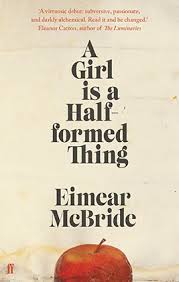
A Girl Is A Half-Formed Thing, by Eimear McBride
Review by JJ Marsh The Baileys Prize Shortlist
The first thing everyone says about this book is ‘it’s a hard read’.
It is. Unconventional in its prose style: confrontational in its subject. McBride’s fractured rendition of conversations and distinctively Irish English, plus the disregard for the norms of punctuation, dialogue tags or attribution makes the reader either work hard or relax.
I recommend the latter. Forget the fact standard reader-signposts are absent and realise you are not being told a story, but being drawn into an experience.
Our unnamed narrator expresses herself and her formative experiences with feeling rather than eloquence– as the author puts it, ‘balancing on the moment just before language becomes formatted thought’.
There is much to think about; familial bonds, the strictures and comforts of religion, the unfairness of disease, perceptions of self and identity as defined in the eyes of others and female sexuality and how it can be (ab)used. McBride neither shows nor tells of the love, shame and guilt battling within our protagonist. By dint of brutal poetry and risky narration, she makes the reader feel it too.
This is the third book I’ve read from independent small publishers Galley Beggar Press, and I’m so glad they exist. Otherwise books like this would not.
You'll like this if you enjoy: James Joyce, Sarah Kane, Samuel Beckett
Avoid if you dislike: risk-taking, no stabilisers, experiential writing
Ideal accompaniments: Hard green apples, sipping vodka and silence so you can hear the music in these words.
Genre: Literary fiction
Addendum: Congratulations, Eimear!!!!
Saturday, 24 May 2014
Born Twice

Reviewer: JJ Marsh, author of The Beatrice Stubbs series.
What We Thought: This is a surprising book. To be honest, I suspected something mawkish and trite, push-button emotional manipulation which causes uncontrollable sobbing and leaves you no wiser than when you started. I was wrong.
The book is a collection of episodes from the life of Professor Frigerio (a name I found resonant) and his son Paolo. Each is told in spare prose, in beautifully crafted sentences – I was already reaching for the Post-Its in Chapter Two. Pontiggia achieves a clinical detachment through his precise, curt chapters, inviting the reader to observe, learn, judge, accept or rail against the circumstances.
Paolo is born severely disabled. This appears to be partly the fault of the medical profession, partly the fault of his wife and her family. The story explores how the professor learns about his own special needs while coming to terms with those of his son. Frigerio suffers guilt surrounding his own infidelity, tests his theoretical opposition to prejudice against disabled people versus his will to have his son conform, battles with his own resentments towards authority, clashes with his wife and older son regarding how to treat Paolo and discovers how much his younger son has to teach him.
It’s not an easy read. It’s sharply painful and the author’s laser-pointed language doesn’t allow for evasion. You are drawn into this world, constantly comparing ‘What would I do?’ while vacillating between sympathy and infuriation with the narrator. It moved me deeply, but more importantly, made me question my own attitudes. Highly recommended for those who, just once in a while, want to examine what a principle really means.
You'll enjoy this if you liked: Oscar Moore's PWA, Far from the Tree by Andrew Solomon, Dr Jamison's An Unquiet Mind.
Avoid if you want: a saccharine weepie with a feelgood ending.
Ideal accompaniments: Iced water with lime, grapefruit and feta salad, and Chopin's Nocturnes.
Genre: Contemporary, in translation
The Bone Garden by Tess Gerritsen

Reviewer: Gillian Hamer, author of The Charter (www.gillianhamer.com)
What we thought: I’ve enjoyed a few of Tess Gerritsen’s Rizzoli & Isles detective novels, and was interested to see this stand-alone novel had a cross-genre tag which tempted me to give it a try – and I wasn’t disappointed.
Like some of my own novels (The Charter and Complicit) Gerritsen writes here both in the present and the past.
Present: Julia Hamill purchases an abandoned property, and after finding human remains in the garden, becomes involved with the history of the house through old letters discovered by the former owner. Past: 1831, Irish immigrant, Rose Connolly struggles to raise her niece Meggie after the childbirth death of her sister. A serial killer roams the streets of Boston, leaving mutilated corpses in its wake, but what connection can the murderer have to a new born infant?
I found both stories satisfying, but the period writing and characters really drew me into the historical thread, and I thought the denouement was very well plotted and all of the strings pulled together cleverly in the finale.
It’s refreshing to read a fellow crime writer who’s not afraid to break a few rules and try her hand a different genre. I think this novel will appeal not only to readers of thrillers, with Gerritsen’s usual amount of shock and gore, but also readers of historical fiction who enjoy period crime writing.
You’ll enjoy this if you like: Barbara Erskine, Susan Hill, Karin Slaughter.
Avoid if you don’t like: Serial killers and Victoriana.
Ideal accompaniments: Dublin Bay prawns, real ale and suet pudding.
Genre: Crime, historical.
Subscribe to:
Posts (Atom)