Showing posts with label Poetry. Show all posts

Monday, 7 March 2022

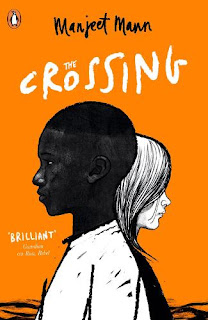
The Crossing by Manjeet Mann


Reviewer:
Catriona Troth

What We Thought of It:

Manjeet Mann’s heartbreakingly beautiful verse novella is a book you will never forget.

Written in a form more familiar in music – where two voices sing (or in this case speak) in counterpoint but not in dialogue – it tells the story of two teenagers, Sammy and Nat.

Nat is a teenager from the south coast of England. She has just lost her mother, and with it so much else. Even her passion for swimming in the sea has turned into a dread of the water.

Half a world away, Sammy is in Eritrea, facing a conscription that is in essence a form of bonded labour with no fixed end point. His only choice is to face a difficult journey out of the country to try and reach the safety he believes he can find in Europe.

We die if we stay, we die if we get caught, we might die in the Sahara, we might die in the sea. But one thing is certain: if we escape – we live.

Written in free verse, the last few words of each section become the first few words of the next, weaving the two voices together as the narrative passes back and forth between them. As Sammy’s journey brings him, step by step, towards the French coast, Nat begins to train to do a cross-channel swim to raise money for refugees. But not everyone in her family supports what she is doing.

I guess migration is only a human right if you’re the right type of human.

In this short and simple text Mann succeeds in illuminating an astonishing range of issues. From Sammy’s story we learn of the often-misunderstood motives that drive young people to flee their homes, the horrors of the journey they undertake, the cruelty of the smugglers who exploit their desperation, and the cold indifference of the bureaucracy that meets them at the edge of freedom. From Nat’s story, we learn of the grinding nature of austerity that leaves some as easy prey to extremists, the trap of white saviourism, and what it takes to be a true ally.

You’ll Enjoy This If You Loved:
Boy, Everywhere by A. M. Dassu; What Strange Paradise by Omar El Akkad; Black Flamingo by Dean Atta,

Avoid If You Dislike: Free verse

Perfect Accompaniment: A walk by the edge of the sea

Genre: Young Adult, Poetry

Buy This Book Here

Thursday, 29 April 2021

My Darling from the Lions by Rachel Long


Reviewer:
Catriona Troth

What We Thought of It:

This complex debut poetry collection by Rachel Long is structured in three parts.

The first part, Open explores issues of sexuality, power, exploitation and consent. Poems such as “Night Vigil”, “Apples” and “8” point darkly to child sexual abuse within a church setting.

“During the Three Members prayer, my sister fell asleep
Under a chair, so she never knew
How I sang. Or how I fell silent
When the evangelist with smiling eyes said in his pulpit voice,
Here child”


“Sandwiches” and “Bike” suggest teenage exploration that may or may not have gone to far and exposed the narrator to danger, while in “Helena” a sex worker relives an act of rape by co-worker.

In a sequence of short poems called “Open”, the poem’s narrator wakes in the morning with her mouth open and her hands in her hair, the pose interpreted for her in different ways by different observers.

“What, mum, like screaming?
She says, No, baby, like abandon”


In the second section – A Lineage of Wigs – the poems revolve around Long’s Nigerian mother and Long’s own experiences as a young child.

“Mum’s Snake” tells the story of a curse put on her by her sister, ultimately forcing her to shave off her hair, while “Car Sweetness” captures a moment of tenderness between her parents.

“Some long journeys back,
Mum would lay her hand
Over Dad’s on the gearstick”


There are poems that recall the experience of growing up as a mixed-race child – her schoolmates doubting her fair-haired father is hers, and contrasting her sister’s long, straight hair to hers. Her scalp burning as her mother cornrows her hair.

“All the ‘sheep’s wool’ they love to touch and say eww to at school
has been harvested into rows at the top of my head:
black crown or web.”


The final section, Dolls, is a more generalised exploration of racism. It begins with a pair of poems in which the story of a racist attack is then played out between three dolls – Barbie, Ken, and the dark-skinned Steve. “Black Princess” then painfully reflects the snobbish and racist treatment of Meghan Markle.

Throughout the book there are other poems that are more surreal – their meaning elusive. This isn’t a collection that gives up its secrets easily – but it is one that more than rewards the effort of close reading.

Shortlisted for the Rathbones Folio Prize, Costa Poetry Award, Forward Prize for best first collection, and the 2021 Jhalak Prize

Listen to Rachel Long reading from My Darling From the Lions at the Coronet Theatre, Nottingham.

You’ll Enjoy This If You Loved: Nudibranch by Irenosen Okojie

Avoid If you Dislike: Poems that refuse to give up their meaning easily, challenging the reader to work things out for themselves.

Perfect Accompaniment: Sugared almonds

Genre: Poetry

Buy This Book Here:

Monday, 26 April 2021

Antiemetic for Homesickness by Romalyn Ante


Reviewer:
Catriona Troth

What We Thought of It:

Romalyn Ante's debut collection is full of poems that track the experiences of two generations of Filipino emigrants who have left their country to work abroad, for the NHS and elsewhere.

Romalyn Ante herself came to the UK when she was 16 and is now a nurse practioner. Her mother, like so many others, had previously left her family behind in the Philippines in order to work for the NHS.

Ante’s poetry unveils the truth behind the flippant comment by the Duke of Edinburgh quoted on the opening page (“The Philippines must be half empty; you’re all here running the NHS”) – laying bare the homesickness, the separation from one’s children, the long hours of hard work for little thanks, the racism…

In “Manananggal” she compares the migrant to a creature from Filipino legend which splits itself in two.

I am halved in order to be whole – I rebuild by leaving everything I love.”

The poems also disclose some of the reasons why these workers stay, even in the face of hardship and hostility. They will cannot leave:

“Not until Junior has got his diploma, not until we have nailed a roof on the house and the pen grunts with pigs […] and we have paid off our parents’ grave plots and our children’s …”

In “The Shaman, The Servant” we can see the contrast between the respect shown to a grandfather who was a shaman, a healer, with the image painted “Invisible Woman”of “goddesses of caring and tending, but no one hears when their skulls pound like coconut shells about to crack.”

Ante reminds us that this is a pattern that has been repeated across generations. In the series of short poems scattered through the book, “Tape Recordings for Mama”, she captures the point of view of a child trying to understand why her mother has left.

The poems blend phrases from Tagalog and elements of Filipino culture and tradition with medical jargon and details of hospital procedure. Ante’s use of language is at once challenging and playful. In the ironically titled “Mastering English”, structured like a test paper, she toys with English idioms,

“The phrase a drop in the ocean indicates:

- Very little in comparison with what is expected or needed

- All the migrants who mysteriously vanished at sea.”

There are also poems that mourn the loss of traditional Filipino culture

“When the colonisers came, their brightness bleached the scripts inscribed on our bamboo stems. Our [memory*] was replaced with their hymn.

*written in Babayin script

These poems blend the deeply personal and specific with the universal sense of loss and longing that any immigrant cut off from home would recognise. Shortlisted for the 2021 Jhalak Prize.

Listen to Romalyn Ante reading from Antiemetic for Homesickness here

You’ll Enjoy This If You Loved: How to Pronounce Knife by Souvankham Thammavongsa

Avoid If you Dislike:  Being reminded of loss and separation

Perfect Accompaniment: A shot of coconut wine

Genre: Poetry

Buy This Book Here:

Thursday, 4 June 2020

A Portable Paradise by Roger Robinson

Reviewer: Catriona Troth

What We Thought of It

Roger Robinson’s collection of poems, A Portable Paradise, begins far from paradise, in the inferno that engulfed Grenfell Tower in London 14th June 2017. These searing poems capture some of the horror of that night – as well as the long struggle for justice that has followed.

How is it I’m begging you for housing, when you burnt my building down?” one voice asks.

In the second section, a series of short, intense poems focuses on artists and writers - from John Milton and George Stubbs, to Jean-Michel Basquiat and Toni Morrison.

The third section is a series of profound reflections on Black History and how slavery and colonialism continue to feed through into the present. The short poem, Beware has, in the last few days, become appallingly timely.

When police place knees
at your throat, you may not live
to tell of choking.


‘It Soon Come’ captures the simmering tensions of the days and hours before anger and injustice boils over on the streets, while in ‘Citizen III’, Robinson gives voice to the Black man who has lived and worked in the UK all his life, only to be told he is to be sent home.

‘The Darkening Red of Your Blood’ is a version of ‘the Talk’ that all Black parents are forced to give their children – especially their sons:

At some point you will be stopped
by the police for no valid reason
They will ask unnecessary questions
They will say something to try
To degrade you
...
Do not fall for it

Do not be the ink of a new obituary

The final section is deeply personal. It deals with such things as an unwanted breakup with a lover and the birth of a severely premature baby with tenderness and love.

The title comes from a poem about Folsom Prison Writing Workshop

Poems can make minds move freely,
Books are a portable paradise
While I am faced with all my guilty freed
om

This book will certainly let your mind move freely. A Portable Paradise is a deeply moving collection and it is not hard to see why it has won both the 2019 TS Eliot Prize and 2020 Ondaatje Prize

You’ll Enjoy This If You Loved: Roy Mc Farlane, The Healing Next Time; Jay Bernard, Surge; Carol Ann Duffy, The World’s Wife

Avoid If You Dislike: Poems that remind you of the fragility of life, or those that force you to confront systemic racism

Perfect Accompaniment: Stormzy: Blinded by your Grace Pt II

Genre: Poetry

Buy This Book Here

Monday, 6 April 2020

Flèche by Mary Jean Chan

Reviewer: Catriona Troth

What We Thought:

Mary Jean Chan’s poetry collection, Flèche, was the Winner of the 2019 Costa Poetry Award and is now longlisted for the 2020 Jhalak Prize.

As a youngster in Hong Kong, Mary Jean Chan was a member of a fencing team and in fencing, flèche is an attacking move. But Chan plays too with its original meaning in French – arrow – as well as its homophone, flesh.

In ‘Practice’ she describes how the androgynous nature of the fencing uniform gave her ‘the closest thing I knew to desire,’ allowing the girls to become ‘princes in a fairytale with a twist, since there were no princesses to be taken, wed.’ Other poems deal with awkwardness of falling in love and the everyday joys Chan shares with her partner.

Chan’s mother grew up in China during the Great Famine and the Cultural Revolution and the sequence, ‘My Mother’s Fables’ deals with the brutalities and deprivations she experienced, the hunger that never entirely left her.

Many of the poems deal with her mother’s struggle to accept Chan’s sexuality and the strain that creates between them. In ‘Conversation with Fantasy Mother’ for example, she imagines a mother who took her coming out “as calmly as a pond accept a stone flung into its depth / You sieved my tears, added an egg, then baked a beautiful cake.” But ‘The Window’ reveals the truth, when she tells herself ‘you will refuse your mother’s rage, her spit, her tongue heavy like the heaviest of stones.’ And with the sequence ‘Twenty-four Filial Exemplars,’ based on a classic Chinese text on filial piety, you feel the weight of expectation that a child should be ready to sacrifice themselves for their parent.

Each poem is a vignette, pared down to its bare essentials, each syllable feeling as if it has been carefully chosen and placed. As she writes in ‘Calligraphy,’ a poem on the instructions for creating perfect Chinese characters,

Seeds of in unfurl suddenly from
Your wrist, blooming into time.


You’ll Enjoy This If You Loved: Do Not Say We Have Nothing by Madeleine Thien, Under the Udala Trees by Chinelo Okparanta,

Avoid If You Dislike: Reading about difficult mother-daughter relationships

Perfect Accompaniment: salted egg and pickled carrot

Genre: Poetry, LGBTQIA+

Buy This Book Here

Thursday, 26 March 2020

Surge by Jay Bernard

Reviewer: Catriona Troth

What We Thought of It:

In 2004, just as I was working on a book that revolved around events in Coventry and London in the first half of 1981, the second inquest into the New Cross Fire opened. One of the firms of lawyers representing families of some of the deceased posted transcripts every night of the day’s proceedings, and it became routine for me to come home from work, sit down at the computer, and read that day’s testimony. Bit by bit I absorbed the horror of the events of that night in January 1981, which led to the deaths of thirteen youngsters who had been attending a birthday party.

Jay Bernard’s research into those events was carried out another fifteen years later, at the Black Cultural Archives in Brixton. Their poems reference original source documents “noted, dated, numbered, placed in acid-free Japanese boxes and lovingly (as is tradition) laid without a casket”. Yet some of the voices are achingly familiar. My breath caught in my throat as one of the poems (Clearing) recalled how a key found in a pocket was used as the only way to identify one of the victims – a never-forgotten fragment of a parent’s testimony to the coroner’s court.

Despite how well I thought I knew those events and their aftermath - especially the almost total lack of action or even empathy on behalf of the authorities – I had missed how close the parallels were with what happened with Grenfell Tower in 2017. But the latter part of Bernard’s collection makes those connections only too clear. Another line that made me gasp – bringing together in just five words, two ends of a long history – was from the poem Sentence, which ends: “Not rivers, towers of blood.”

An immensely powerful collection of poems that evokes events seared onto Black British consciousness, while making it abundantly clear why they should never be forgotten and how little has changes in the intervening forty years.

Finally, I must mention the cover design by Lily Jones. Its swirling black and white lines evoke both the smoke from a fire and the twisting lines of paint in Edvard Munch’s The Scream

You’ll Enjoy This If You Love: Linton Kwesi Johnson, Roy McFarlane

Avoid If You Dislike: Mixing poetry and politics

Perfect Accompaniment: A visit to the Black Cultural Archives in Brixton

Genre: Poetry

Buy This Book Here

Monday, 16 March 2020

The Black Flamingo by Dean Atta, illustrated by Anshika Khullar

Reviewer: Catriona Troth

What We Thought:

“Who is the Black Flamingo? ... He is me, who I have been, who I am, who I hope to become. Someone fabulous, wild and strong.”

Dean Atta’s The Black Flamingo is unlike anything else I have ever read - and I consumed it in two glorious gulps. A joyous celebratory prose poem, it follows the life of a mixed-race (Jamaican / Greek-Cypriot) gay man growing up in London – from a small boy longing for a Barbie to play with, through primary school and high school, to finding a home and family among the Drag Society at University.

It is a story of love and friendship, of acceptance and rejection. Of the complexities of identity. Of the intersections of racism and homophobia, and the strength it takes to overcome them and to be fully and freely yourself.

How to Come Out as Gay
Don’t.
Don’t come out unless you want to.
Don’t come out for anyone else’s sake
Don’t come out because you think society expects you to.
Come out for yourself.
Come out to yourself.


The simplicity of the language is deceptive. By allowing Michael/Michalis/Mikey/Mike to speak to us directly, in his own voice, whatever his age, Atta gives his words a heart-stopping immediacy, while at the same time exploring some profound ideas.

The text is dotted throughout with Anshika Khullar’s beautiful black and white illustrations, which seem to beckon you from page to page. There are WattsApp conversations and facsimiles of notebook pages. There are pages where the text is white on black.

An absolute joy to read – this is a book I’d like to put in the hands of every teenager and young person still trying to figure out who they are. It’s a celebration of acceptance, support and the pleasures of finding what Anna Madrigal would have called your logical family.

Longlisted for the 2020 Jhalak Prize.

You’ll Enjoy This If You Loved: The Perseverence by Raymond Antrobus, Jonny Appleseed by Joshua Whitehead, Moonlight (film)

Avoid If You Dislike: Prose poetry. Explorations of gender and sexuality (but I’d say give it a try anyway – you may surprise yourself!)

Perfect Accompaniment: Back to Black by Beyoncé

Genre: Defies classification. Poetry. Lit Fic. YA. LGBTIAQ+

Buy this book here

Tuesday, 23 July 2019

The Healing Next Time by Roy McFarlane

Reviewer: Catriona Troth

What We Thought:

Longlisted for the 2019 Jhalak Prize, The Healing Next Time, by the former Poet Laureate of Birmingham, Roy McFarlane, comprises three sequences of poems that rage against the violence inflicted on Black people by the state. Reminiscent of poems like Di Great Insohrekshan and Inglan is a Bitch by Linton Kwesi Johnson, which were written in the wake of the New Cross Fire and the Brixton Uprisings of 1981, The Healing Next Time moves the story on another 30 or 40 years and, sadly, shows how little has changed.

The first sequence, ‘New Millennium Journal’ records moments – public and private – in the life of a man referred to as ‘the activist’ or ‘the family man’ between 1999 and 2007 – weaving together his relationship with his wife, his lover, his mother and his children with events such as the Brixton bombings and the Bradford riots

The second sequence, ‘...they killed them,’ is written in honour of some of those who have died in police custody – some well known, like Joy Gardner, Cherry Groce, Mark Duggan, Rashan Charles, but many others whose names and stories have been forgotten or were never heard.

In the final sequence, ‘Gospel According to Rasta,’ Rasta becomes a personification of everything that drives McFarlane to write.

One poem in particular in the third sequence jumped out at me. I first saw Chris Ofili’s painting No Woman No Cry when Freedom From Torture’s Write to Life Group were creating poems based on art works in the Tate Gallery. Here it inspires McFarlane just as then it inspired Ugandan torture survivor Jade Amoli Jackson.

Powerful poetry with a voice and rhythm that leaps off the page.

You’ll Enjoy This If You Love: Linton Kwesi Johnson, John Agard

Avoid If You Dislike: Powerful political poetry

Perfect Accompaniment: Roast breadfruit, ackee and saltfish.

Genre: Poetry

Available on Amazon

Saturday, 27 April 2019

The Perseverance by Raymond Antrobus

Shortlisted for The Jhalak Prize
The Jhalak Prize for Book of the Year by a Writer of Colour, is an annual literary prize awarded to British or British-resident writers. It is the first and only literary prize in the UK to only accept entries by writers of colour.

Reviewer: Catriona Troth

What We Thought:

Raymond Antrobus’s stunning debut poetry collection, The Perseverance, has been shortlisted for both the 2019 Jhalak Prize and the 2019 Griffin Poetry Prize International.

Antrobus is Deaf. (The capital letter distinguishes between those who are born Deaf and who regard Deafness as part of their culture and identity rather than a disability, and those to become deaf later in life, whose relationship with deafness is primarily medical.)

For Antrobus, late diagnosis as a child led to years of low expectations. When he attended a Deaf School in London attached to a hearing school where he had many of his lessons. There, hearing children mocked him for using sign language, while Deaf pupils mocked him for his lack of fluency. In Echo, A Deaf Sequence, as essay he wrote for poetryfoundation.org, Antrobus writes: “This was when I most needed the nurturing of a Deaf identity, one that wasn’t medical, but philosophical, one that embraced my natural of language and valued Deafness as a way of being."

Many of the poems in this collection address the experience of being Deaf. He rails against the othering of the Deaf – writing poems that respond to Ted Hughes’ Deaf School, and to Charles Dickens writing about Laura Bridgman (a Deaf-Blind woman born fifty years before the more famous Helen Keller) or his sentimental tale, Doctor Marigold.

He confronts the murder of three deaf women street vendors in Haiti in 2016, and the fatal shooting by a state trooper in America of a deaf driver trying to use sign language.

In Dear Hearing World (a poem which plays on Dear White America by Danez Smith), Antrobus challenges reluctance of the education system to recognise the validity of sign language as a means, not a barrier to communication – an attitude that goes right back to Alexander Graham Bell.

The Perseverance of the title refers in part to the pub in Broadway Market in London where his alcoholic father drank. Many of these poems were written shortly after the death of his father, who he nursed through the last two of his life as he suffered from dementia, and explore different aspects of their relationship.

There is ambiguity too in his mixed race identity, which he explores in (Jamaican British / Miami Airport / Maybe I Could Love a Man)

Poetry does not take you by the hand and lead you, as fiction does. It demands work from the reader to chisel out meaning. I found myself spending time delving back into Antrobus’s references before reading the poems again. I also sought out YouTube videos of Antrobus performing his poetry, to hear the spaces he left between words and where he placed the stresses. It was effort well worth putting in, as it opened up layers of understanding and appreciation.

This is an exceptionally talented poet at only the start of his career. As he points out, Deaf culture has too often been silenced, patronised, othered and misrepresented. Antrobus’s cuts through that with shining clarity.

You’ll Enjoy This If You Loved: Kumukanda by Kayo Chingonyi

Avoid If You Dislike:Having to put a bit of work into your reading 

Perfect Accompaniment: Red snapper, rice and peas, and a few lessons in BSL

Genre: Poetry

Buy the book here.

Wednesday, 14 March 2018

Kumukanda by Kayo Chingonyi

Reviewer: Catriona Troth

What We Thought:

I love listening to poetry in performance, but I am not always good at reading it on the page. Too often, inside my head, the poet’s voice turns into a meaningless sing-song. Fortunately for me, the voice in Kayo Chingonyi’s Kumukanda was strong enough to override even my cloth ear.

Chinogonyi was born in Zambia in 1987 and came to the UK in 1993. The title of this debut volume of poetry, Kumukanda, refers to the initiation rites that young boys of the Luvale, Chokwe, Luchazi and Mbunda people in north western Zambia must pass through to be considered a man.

“Tata’s people would think me unfinished – a child who never sloughed off the childish estate to cross the river boys of our tribe must cross in order to die and come back grown.”


As the author says, ‘This book approximates such rites of passage in the absence of my original culture.’

The book begins with poems about growing up in south London and a ‘white flight’ town outside London, about his relationship with music and rap and how that helped forge his identity. But Chingonyi moves on from that. In poems such as The ‘N’ word, Casting and Callbacks, he addresses casual racism. In Legerdemain and How To Build Cathedrals, he confronts colonialism and in Kung’anda (home) the Western eye view of Africa reduced to the image of a dying child.

The Nod, Loch Long by Ardarten, Argyll and In Defence of Darkness are love poems of breathtaking tenderness and sensuality. In Curfew, he glimpses the rebellious young woman who is now is Auntie.

A whole group of poems, including the title poem, Kumukanda, address the loss at a young age of both his mother and his father. There is humour here as in the description of his father, “him stood, sequoia among lesser trees, looking good in denim.” And heartbreak, as when he writes of his terminally ill mother, “She’s dying but I won’t call her dead, can’t let mum become a body, a stone, an empty hospital bed.”

Chingonyi said, in an interview with the ICA Bulletin in 2016, that one of his aims in writing is to “chip away at the motion that whiteness is the normative unmediated position from which all other subjectivities deviate.” Which makes him a perfect fit for the Jhalak Prize shortlist.

You’ll Enjoy This If You Loved: Lemn Sissay, Tendai Huchu, Malika Booker

Avoid If You Dislike: Poems that combine lyrical beauty with razor-sharp political commentary

Perfect Accompaniment: Mussels and dry white wine

Genre: Poetry

Available on Amazon

Wednesday, 7 December 2016

A Country of Refuge by Lucy Popescu (editor)

Reviewer: Catriona Troth

What We Thought: In the past few years, the issue of refugees has been brought to the attention of the Western world in a way unprecedented since the end of the Second World War. Yet despite Britain priding itself on its long history as a country of refuge, and despite moments when individual images have roused us to compassion, most of what we see and hear about migrants and refugees has been overwhelmingly negative.

This anthology seeks to redress the balance and open readers to a deeper understanding of what drives ordinary people to flee their homes to make a life in a new country. It has been put together by Lucy Popescu, who for the last five years has worked as a volunteer mentor in the Write to Life programme of Freedom from Torture, hearing at first hand the terrible stories of refugee victims of torture, but also discovering their enduring warmth and resilience.

The anthology comprises a mixture of short stories, essays and poems. Given the prominence of refugees in the news, it seems extraordinary to me that publisher after publisher turned it down. So hurrah for Unbound, with their crowdfunding model of publication.

Though the authors are not, for the most part, refugees, many of the stories are drawn from the experiences of family. Sebastian Barry’s ‘Fragment of a Journal, Author Unknown’ takes us back to the ordeal of the Irish famine. Alex Wheatle recalls his father’s journey from Jamaica and Nick Barlay, his parents fleeing Hungary in 1956 as the Soviet tanks rolled in. Katharine Quarmby reflects on her family’s complex mix of migrants and refugees.

In ‘To Avoid Worse’, Joan Smith notes that the romanticisation of the story of Anne Frank obscures that fact that, before they went into hiding, her father tried desperately to get his family out of the country, but was refused visas by countries that might have given them refuge – and draws parallels with the family of Aylan Kurdi.

Hassan Abdulrazzak, who came to Britain with his family as a child refugee from Saddam Hussein’s Iraq, reflects on how easy their path now seems in comparison with those trying to escape the war in Syria.

Some of the short stories seem designed to make us squirm. The narrator in Stephen Kelman’s ‘Selfie’ wants the man selling selfie sticks on the streets of Rome to understand he is different from all the other people ignoring him, even though he’ll do nothing to help him. In AL Kennedy’s ‘Inappropriate Staring’ two people eat their lunch outside the high fence of a detention centre while discussing the detainees like animals in the zoo. In Marina Lewyska’s ‘Hard Luck Story’, a security guard turns a deaf ear to the pleas of a woman he must put on a plane back to the country she fled.

Courttia Newland turns the tables on us, and imagines British citizens fleeing towards the coast, hoping to make it to a safe haven somewhere like Syria. Amanda Craig’s 'Metamorphosis' wreaks Kafka-esque revenge on one of Britain’s nastiest media commentators.

Roma Tearne contributes two heart-rending stories about families torn apart, one from Sri Lanka, one from Iraq. In ‘Shakila’s Head’ by Kate Clanchy, a teacher running a poetry writing class confronts some of the terrible things her young charges have experienced.

There is poetry from Ruth Padel, Hubert Moore and Elaine Feinstein, and essays from Hanif Kureishi, Noo Saro-Wiwa and William Boyd.

The final essay, by AL Kennedy, updated from a lecture she gave at the European Literature Days Festival in October 2015, warns us that the path that leads to a culture of cruelty is well known and that we are in danger of following it. She calls upon artists, and writers in particular, to fight against this. “We can make dreams to lead mankind forward and expressions of individuality that can make many free,” she writes. “Without those dreams, we face only nightmares.”

A much needed antidote to mass media vitriol, and a reminder of the humanity of each and every individual forced to flee their own country.

You’ll Enjoy This If You Loved: Moving a Country by Jade Amoli-Jackson; From There to Here (Second Decibel Penguin Prize anthology); In Protest: 150 Poems for Human Rights, Helle Abelvik Lawson, Anthony Hett and Laila Sumpton (editors)

Avoid If You Dislike: Having your preconceptions challenged

Perfect Accompaniment: Tea and humble pie.

Genre: Short Stories, Poems and Essays

Available on Amazon

Thursday, 1 October 2015

Mimes Chimes and Rhymes by Ian Graham

 
Reviewer: Barbara Scott Emmett, author of Delirium: The Rimbaud Delusion, Wasps & Scorpions: Luv Pomes and Other Lies and former judge of Flash 500 Humour Verse Comp. (http://barbarascottemmett.blogspot.co.uk/)

What We Thought: Mimes Chimes and Rhymes is a quirky book featuring verses by Ian Graham and drawings by Emilie Vercruysse. A slight volume, it nevertheless has scope to be clever, funny and thought-provoking.

The verses tend to be short and to the point; the accompanying drawings are kitsch and sometimes sweet.

The poems offer a variety of line schemes to keep the reader interested and though seeming sometimes to be mere frivolities closer inspection reveals depth. They tackle verbal absurdities and play with the meanings of words and phrases; being more than puns however, they also delve into the meaning of life.

Well worth a look if you enjoy verse that takes a sideways look at things.

You’ll enjoy this if you like: Playfulness with words.

Avoid if you dislike: Puns.

Ideal accompaniments: French Toast with a little cognac to taste.

Genre: Poetry, Humorous Verse.

Available from Amazon

Wednesday, 5 August 2015

The Peculiar Life of a Lonely Postman by Denis Theriault (trans. Liedewy Hawke)

Reviewer: Barbara Scott Emmett, author of Delirium: The Rimbaud Delusion, The Land Beyond Goodbye and Don’t Look Down (http://barbarascottemmett.blogspot.co.uk/)

What We Thought: Bilodo, a postman in Montreal, has been opening other people’s letters for some time. After he has read them he always seals them up and delivers them, so he considers this secret vice to be a hobby rather than a crime. He only opens personal correspondence – the real letters, the handwritten ones – and this way he encounters Ségolène.

Ségolène lives in Guadaloupe and regularly sends haikus to a local poet, Gaston Grandpré. Bilodo finds her letters thrilling and chastely arousing. So taken is he with this unknown and far off woman, he fails to register the interest of the very real Tania, a waitress at his favourite lunchtime haunt.

When Grandpré is knocked down in the act of attempting to post a letter to Ségolène, Bilodo’s life changes and what was a ritualistic pleasure becomes a dangerous obsession. Driven by the desire to take over the correspondence with Ségolène, he has to learn everything he can about the art of the seventeen-syllable haiku and the longer more sensual tanka. As Bilodo immerses himself in the poetic forms, the reader too learns about Japanese culture and poetry.

The Peculiar Life of a Lonely Postman is a strangely delightful little book. Though told mainly in prose, sometimes the short poems themselves carry the story. The torrid lovemaking shown entirely through a series of exchanged tankas has to be the funniest literary orgasm since the Nausicca scene in Ulysses. I do hope the emphasis on poetry doesn’t put anyone off, though – this little novel is a fast read and it sweeps nimbly along to its inevitable conclusion. Philosophical, circular and implacable it reflects Bilodo’s life and the lives of those who may emulate him. Step off the wheel, it seems to say, and avoid the mistakes of repetition and blinkered infatuation with that which is not real.

You’ll enjoy this if you like: Quirky flights of fancy with a touch of zen.

Avoid if you dislike: Japanese poetry.

Ideal accompaniments: Ceremonial tea taken while wearing a kimono; traditional Japanese koto music.

Genre: Literary Fiction. Poetry.

Available from Amazon