Genres
Monday, 13 December 2021
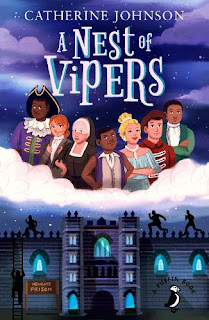
A Nest of Vipers by Catherine Johnson
Reviewer: Catriona Troth
What We Thought of It:
I grew up loving the novels of Leon Garfield – with a special fondness for Smith. Catherine Johnson’s A Nest of Vipers plunges the reader into the same world of 18th Century London – but populated this time with a rich cast of characters reflecting the diversity that most of us are only now learning was the reality in London at that time.
Cato is a member of a gang of con artists who live at the Nest of Vipers (‘the best inn in London’), making a living from tricking wealthy fools of their money. They are led by Mother Hopkins, who has taken them all under her wing and given them a home. But now she’s getting older and she dreams of one last con – one so big they will be able to escape London, buy a house in the country and live out their days in peace.
But things have got out of hand. Cato has been caught – his gang, who he thought of as family – apparently abandoning him to the hangman’s noose. All that is left for him now is to tell his story to the Ordinary of Newgate – the prison chaplain whose job it was to record the last words of condemned prisoners and then sell them to an eager public, like the true-crime podcasts of their day.
Full of humour, colour and rich historical detail. We visit the Frost Fair on a frozen River Thames and learn about the sedan chairs that were the antecedents of modern taxis. We also come face to face with the uncomfortable true that there were house slaves bought and sold in the middle of London itself, and made to wear silver collars as a badge of ownership.
A book to delight any young history buffs out there.
You’ll Enjoy This If You Loved: Freedom by Catherine Johnson; Smith by Leon Garfield; Black Hearts Over Battersea by Joan Aitkin; Black and British: a short essential history, by David Olusoga
Avoid If You Dislike: Heroes from the wrong side of the law
Perfect Accompaniment: Hot pie with gravy.
Genre: Middle Reader, Historical
Buy This Book Here:
Thursday, 2 December 2021
The Shadows of Men by Abir Mukherjee
Reviewer: Catriona Troth
What We Thought of It:
"Placing oneself in a position of semi- permanent hypocrisy, that’s what it meant to be an Englishman in India. […] God knows there were enough embittered, broken colonial men and women of good conscience, driving to drink and ruin by the irreconcilable absurdity at the heart of it all: the claim that we were here for the betterment of this land, when all the time we merely sucked it dry."
This is the fifth outing for the redoubtable pairing of Sam Wyndham and Surendranath Banerjee – and the first time Suren has been given his own voice. “Of course that is unlikely to stop [Sam] sharing his two annas worth […] but that is Sam for you, and this is why you require to hear my side of the tale.”
The year is 1923. Gandhi’s general strike has been called off in the wake of a wave of violence. The Indian independence movement has collapsed into ‘a morass of in-fighting and mutual recriminations’ and there are those on all sides who are ready and willing to exploit the simmering tensions between Hindus and Muslims.
At the opening of the novel, Suren has been sent by the Commissioner of Police to tail a Muslim politician from Bombay who has arrived unexpectedly in Calcutta and is suspected by the authorities of being up to no good. Following him to a poor and ramshackle riverside township, Suren is eventually led down a gullee into a trap and knocked out. The first Sam hears of all this is when he learns that Suren has been arrested on a charge of murder.
Before they know it, the two are caught in the beginning of a yet another wave of communal violence and it seems that the harder they try to prevent it, the more they succeed in fanning the flames. Unexpectedly allied with their old nemesis, Colonel Dawson of Section H, Sam and Suren find themselves on their way to Bombay, working outside the law and under assumed identities.
Mukherjee continues to write highly entertaining crime novels that cast a fresh light both on a seminal period in India’s history and on its echoes in the world today. As time has passed for Sam and Suren since the first book, we see ever more clearly the tensions – some inherent and some deliberately stoked – that would make the path to independence so treacherous. This latest book also lifts the lid on the simmering dangers of populism – in India and around world. “My novels reflect what is happening now, what it is that makes me angry,” Mukherjee says [in an interview in The Times, November 2021]
Perhaps the reason that the pairing of Sam and Suren works so well is that they reflect (as Mukherjee told E.S. Thomson at the launch of The Shadows of Men at Portobello Bookshop) the two sides of his own personality – Sam the cynical Scot and Suren the optimistic, questioning Bengali. Suren’s wry observations, given full voice now that he can tell his own half of the story, are something to treasure:
“When an Indian overcharges an Englishman, it is termed fraud, but when an Englishman overcharges an Indian, it’s called capitalism.”
If there is one problem with Mukherjee’s writing, it's that we’ll have so long to wait for the next installment!
You can listen to the whole of Abir Mukerjee’s conversation with E.S. Thomson here.
You’ll Enjoy This If You Loved: Vaseem Khan’s Malabar House series; Leye Adenle’s Amaka series; any of the previous books in the series.
Avoid If You Dislike: Poking fun at British arrogance
Perfect Accompaniment: Machher-jhōl (Bengali fish curry with mustard oil)
Genre: Crime, Historical Fiction
Buy This Book Here:
Tuesday, 17 August 2021
The Fortune Men by Nadifa Mohamed
Reviewer: Catriona Troth
What We Thought of It:
In 1952, merchant seaman and occasional petty thief, Mahmood Mattan is put on trial for the brutal murder of Cardiff shopkeeper Lily Volpert. You wouldn’t hang a dog on the evidence brought before the court – but Mahmood is a Black man in post-war south Wales. He was hanged on 3rd September 1952, the last person to be executed in Wales. Almost half a century later, he became the first person to have his conviction quashed under the newly established Criminal Cases Review Commission.
In this superb novel by Nadifa Mohamed, shortlisted for the 2021 Booker Prize, Mahmood Mattan is finally given the voice he was never afforded in life. Mohamed has immersed herself in the details of Mahmood’s life to give us a fully rounded picture of the man. We don’t just walk beside him through the trial, onto death row and ultimately through the doors of the execution chamber: we are inside his mind. We inhabit his sense of his own innocence and his faith in British justice, his rage when it fails him, the meditative state he reaches (for a time) when contemplating his own death.
The Fortune Men serves to remind us that Cardiff is one of the oldest established multi-ethnic communities in the UK, that is was a place of “robed Yemenis and Somalis marching to celebrate Eid, of elaborate funeral corteges for the last of the rich captains of Loudon Square, of Catholic children clad in white on Corpus Cristi […] of makeshift calypso bands busking to raise enough money to tour the country, of street dice games descending into happy laughter or nasty threats, of birdlike whores preening their feathers to catch a passing punter.”
But it was also a place of entrenched racism, where “a woman had given him a real stinker of a look, a real ‘get back in your mother’s hole’ look. At him! With his three-piece suit and silk scarf, while the old bat had on a rain jacket that hadn’t seen a laundry since the war. It was too much.”
Deep as we are in Mahmood’s mind, the story is not told in the first person, and that gives us the perspective to see the myriad ways in which, in the context of entrenched attitudes, Mahmood becomes the author of his own destruction: when he lies and dissembles and pretends to be something he is not, when simple honesty might have served him better.
We also get to meet Mahmood’s Welsh wife, Laura, with whom relations are strained at time of his arrest, but who remained loyal to him to the very end and who never stopped fighting to clear his name. We get a sense of their relationship, complicated but full of warmth.
Nor does Mohamed forget the victim and her family, for whom justice is not served. What is it like to know that someone you hold dear has been brutally murdered while you sit, on the other side of a wall, eating supper, telling a joke, looking forward to going to a dance? How do you deal with the aftermath of that?
An exceptional novel, grounded in a little-known slice of British history, that lays bare the human consequences of racism and injustice.
It is well worth reading this interview with Mohamed about her inspiration for writing this book, and the process by which she immersed herself in Mahmood’s life.
And for more background on Cardiff’s multicultural history, I can recommend Sean Fletcher’s documentary for S4C: Terfysg yn y Bae [Trouble in the Bay], which covers the Cardiff Race Riots of 1919. (Includes English-language subtitles.)
You’ll Enjoy This If You Loved: The Confessions of Frannie Langton by Sara Collins, A Death in the East by Abir Mukherjee, The Empty Vessel by JJ Marsh,
Avoid If You Dislike: A close-up perspective of life under a sentence of death
Perfect Accompaniment: A mug of strong tea and ‘We Three’ by the Ink Spots
Genre: Literary Fiction, Historical Fiction
Buy This Book Here
Wednesday, 4 August 2021
The Dying Day by Vaseem Khan
Reviewer: Catriona Troth
What We Thought Of It:
As a lifetime fan of Golden Age Detective Fiction (especially the novels of Dorothy L Sayers) and a bit of a Dante obsessive, this book could have been written for me!
This is the second outing for Persis Wadia, India’s first female police inspector. This time she is summoned to the offices of the Royal Asiatic Society because one of their senior researchers has gone missing – along with a priceless manuscript of Dante’s Divine Comedy, whose loss has the power to trigger a major diplomatic incidence.
The initial assumption is that Healy, the researcher, must have stolen the manuscript. But if so, why has he left behind a series of cryptic clues? And where are they leading?
At the same time Persis is trying to wrestle with her own complicated feelings towards her rumpled forensic colleague, Archie Blackfinch, as well as the problem of the dead body of a high-class white prostitute, found dismembered by the railway line.
Persis is faced with a range of clues from riddles and cryptic crosswords to full-on book ciphers (a favourite of DL Sayers). We are led from the Divine Comedy via Alice Through the Looking Glass to the King James Bible. Khan, no doubt wisely, avoids getting bogged down in the intricate details of how to solve a book cipher, but leaves plenty to challenge the little grey cells.
Persis Wadia’s debut outing, Midnight at Malabar House, has just won the 2021 Historical Dagger Award for Crime Fiction. This, the second novel in the series, does not disappoint! It is a fascinating and nuanced portrait of a newly independent India, as well as a mystery that would delight the original members of the formidable Detection Club.
(I can highly recommend the excellent Red Hot Chilli Writers podcast, hosted by Khan and his fellow masala-noir author, Abir Mukerjee. If you listen, you might just detect an echo of the bickering of Persis’s father and his friend Dr Aziz in the banter between the two hosts.)
You’ll Enjoy This If You Loved: Midnight at Malabar House by Vaseem Khan; Have His Carcase by Dorothy L Sayers.
Avoid If You Dislike: Literary puzzles
Perfect Accompaniment: Lime and soda
Genre: Crime, Historical Fiction
Buy This Book Here
Monday, 28 June 2021
At Night All Blood Is Black by David Diop, trans Anna Moschovakis
Reviewer: Catriona Troth
What We Thought Of It:
“Temporary madness in war is bravery’s sister.”
At Night All Blood Is Black is the English-language title of Frère d'âme (lit, “the brother of my soul”), a novel by the French author of Senegalese extraction, David Diop. With his English translator Anna Moschovakis, Diop won the 2021 International Booker Prize for this – the first French-language novelist to do so.
Set in the trenches of the First World War, the novel reveals the terrible damage war can wreck on the human mind – as well as reminding us that soldiers from colonised Africa (“chocolats” in the French slang of the time) were fighting and dying alongside white soldiers (“toubabs”).
Alfa Ndiaye has witnessed the death of his childhood friend, “my more-than brother”, Mandemba Diop. Mandemba died in agony, his guts spilling out over no-man’s land, but Alfa could not bring himself to do as his friend begged him and slit his throat to put him out of his agony. His guilt at his failure to do so turns him into a kind of avenging spirit, haunting the battlefields and inflicting on the German soldiers “the blue-eyed enemy from the other side” what they inflicted on Mandemba.
Diop uses patterns and tropes of African storytelling in the structure of the novel – patterns that are also reminiscent of Old English sagas like Beowolf. Certain phrases repeat over and over again like the beat of a drum. (God’s truth … my more than brother … I, Alfa Ndiaye, son of the old man…) And Alfa’s feats, at first legendary, slowly turn him from hero in the eyes of his fellow soldiers, into a madman or perhaps a sorcerer.
Alfa’s memories of growing up in Senegal with Mandemba also touch on the impact of colonialism on Africa, as village elders are pressured to turn from subsistence farming to cash crops, leaving them dependent on outside buyers into order to feed their families.
Diop, and his translator, use extraordinarily beautiful language to paint a picture of the extreme ugliness of war. Alfa believes he betrayed his friend, but in truth, he, like the soldiers around him, have been betrayed by those who led them into war and who use them as human sacrifices in the interminable futility of trench warfare.
There have been so many novels set in those First World War trenches, that to write something new and unique is an extraordinary achievement. Diop may very well have done just that.
You Will Enjoy This If You Loved: The Shadow King by Maaza Mengiste, The Song of Achilles by Madeline Miller, The Regeneration Trilogy by Pat Barker
Avoid If You Dislike: Graphic descriptions of war and war wounds
Perfect Accompaniment: A glass of mint tea
Genre: Literary Fiction, Historical Fiction, In Translation
Buy This Book Here
Thursday, 3 June 2021
The Yield by Tara June Winch
Reviewer: Catriona Troth
What We thought of It:
After a long absence, August is returning to her home in
Massacre Plains, a remote part of central Australia, to attend the funeral of her
grandfather, Poppy Albert. But when she gets there, she finds that even her
families last fragile hold on what used to be their ancestral land is threatened
by the development of a tin mine.
The Yield weaves together three narratives. There is August’s
story, of reconnecting with her family, of coming to terms with the loss of Poppy
Albert, and of her growing conviction that they could fight the incursion of
the mine.
The second is an extended letter, written by the white pastor
who set up the original mission on Massacre Plains to protect the local
Aboriginal people. His letter both documents the extent and brutality of the
atrocities committed by white settlers and reveals the some of the damage caused
through his own good intentions.
Finally, there are Poppy Albert’s own writings – his attempt
to create a dictionary of his people’s original language. Each word that he
captures has a story to go with it – and those stories tell something of the
traditions of the original inhabitants of Massacre Plains, of their custodianship
of the land and of the environmental degradation brought about through ignoring
that deep knowledge. But fragment by fragment
they also reveal the devastating truth behind the family tragedy that led to
August leaving Massacre Plains.
Poppy’s dictionary underlines the importance of reclaiming
language, because a language reveals a whole different way of thinking. As Poppy
says, it sings mountains into existence.
Like this year’s Jhalak Prize winner The First Woman, The
Yield explores the intergenerational impact of colonialism – but this time
through the lens of an Indigenous people who were all but wiped out by white
settlers in the course of their insatiable land grab. It also reflects on how
ignorance and the wilful rejection of traditional knowledge and practice has
led to the destruction of a delicate ecological balance.
Achingly beautiful. A devastating tally of the cost paid by the
relentless drive to expand European ‘civilisation,’ yet containing within it a
small flame of hope that some of what has been lost can still reclaimed.
You’ll Enjoy This If You Loved: The First Woman by Jennifer Nansubuga
Makumbi, The Break by Katherena Vermette
Avoid If You Dislike: Confronting the devastating impact of
colonialism on a land and its people.
Perfect Accompaniment: Freshwater fish, grilled and flavoured
with herbs.
Genre: Historical Fiction, Contemporary, Indigenous Writing, Literary Fiction
Thursday, 8 April 2021
The First Woman by Jennifer Nansubuga Makumbi
Reviewer: Catriona Troth
What We Thought of It:
Set in Uganda during the time of Idi Amin, the Ugandan-Tanzanian War and their aftermath, The First Woman is the story of Kirabo, a young woman from a rural community walking a tightrope between tradition, Europeanisation, and Amin’s despotism.
When the story opens, in 1975, Kirabo is 12, the youngest of an extended family of young people living in the care of her grandfather while they go to school. A gifted storyteller, Kirabo uses her talent to boost her status among the older children.
Beloved as she is of her grandparents, Kirabo’s greatest frustration is that no one will tell her anything about her mother. So she sneaks off to visit her grandmother’s great rival, Nsuuta, their almost-blind neighbour who is reputed to be a witch.
Nsuutu tells her about women’s original state, when “We were not squeezed inside, we were huge, strong, bold, loud, proud, brave, independent. But it was too much for the world and they got rid of it.” But Kirabo is one of those rare children in which the original state is reborn.
At first, Kirabo rejects the First Woman within her, symbolically burying it in Nsuutu’s yard, but as the story progresses, she begins to understand more of how women are repressed, not just by men, but by other women who have absorbed the values of a patriarchal society. Trapped like hens in a cage too small, they turn and peck at one another.
The First Woman follows Kirabo as she goes to live in the city with her father and her un-welcoming stepmother, via her admission to an elite boarding school run by nuns, through love, loss and rejection to the beginnings of maturity as a young woman.
Makumbi’s masterful text manages to balance regret for the loss of what was good in traditions driven out by Christianity and Europeanisation, with a trenchant critique of the patriarchy and internalised misogyny embedded in traditional Ugandan communities.
The story ends in 1983, but one heart-breaking line seems to foreshadow some of Uganda’s more recent pains. In 1979, Kirabo is in boarding school as the war with Tanzania comes closer and closer, but “No parents had come to fetch their girls because nowhere was safer for them than boarding schools. Even Amin’s men would never attack a school.” Sadly, by 1996, the Lord’s Resistance Army had shown it had no such scruples.
Just as the oral story-telling traditions the young Kirabo aspired to wove life-lessons into spell-binding tales, Makumbi weaves commentaries on colonialism, patriarchy, colourism and internalised misogyny into this tender coming of age story.
WINNER of the 2021 Jhalak Prize.
You’ll Enjoy This If You Loved: The Girl With A Louding Voice by Abu Dare, Nervous Conditions by Tsitsi Dangarembga
Avoid If you Dislike: Stories of woman reclaiming their power
Perfect Accompaniment: Groundnut stew
Genre: Literary Fiction, Coming-of-Age story, Modern Historical Fiction
Buy This Book Here:
A More Perfect Union by Tammye Huf
Reviewer: Catriona Troth
What We Thought of It:
"Where is the liberty and freedom and rights and justice, when the law says Matthew Johnson owns my child after already owning my wife? What kind of Constitution for the people allows a thing like that? I country can claim that wrong is right, but that’ll never erase the stain of it."
A More Perfect Union opens with the young Irish labourer, Henry, already driven to the brink of starvation by the venality of his English landlords, facing the horror of another blighted potato crop. When both his parents die within days of each other, he boards a ship for a new life in New York, only to find himself thwarted by yet more anti-Irish prejudice.
Meanwhile, Sarah is sold away from her family on a plantation in Virginia. She narrowly avoids being bought by a man who would clearly use her as a ‘bed-warmer,’ and is taken instead to a plantation run on ‘Christian’ principles, where the slaves are well fed and housed, and whippings are comparatively rare. Yet it remains to case that Sarah’s life is not her own.
When Henry heads south for the life of a travelling blacksmith, their paths cross and there is an immediate (and forbidden) attraction between them – and on one level, more that unites them than divides them. But could Sarah ever see Henry as anything other than another white Master, especially when he is employed to forge shackles to be used on slaves? And can Henry see past the relative security of Sarah’s life and understand what it means that – for Sarah or even her children, or her children’s children – there would never be the faintest possibility of boarding a ship for another life?
It seems impossible that this story could have a happy ending, but Sarah and Henry find a love so deep that neither is willing to give up until all hope is lost.
Through this deeply personal tale, Huf reveals the desperate tragedy of both the Irish famine and slavery of the Southern plantations – while at the same time demolishing any false equivalence between them.
The novel shows up, too, the ugly hypocrisy of those who preached Christian principles, who claimed that it was ‘benevolent’ slavery was possible, but who viewed an escaping slave as a thief stealing from his master and thought for a white man to want to marry a black woman is “the most immoral proposal ever put.”
A beautiful story made all the more extraordinary with the knowledge that it was inspired by the true story of the author’s own great-great-grandparents.
You’ll Enjoy This If You Loved: The Vanishing Half by Brit Bennett, The Underground Railroad by Colson Whitehead, The Last Runaway by Tracy Chevalier
Avoid If you Dislike: The demolition of comforting myths about slavery and white complicity.
Perfect Accompaniment: A picnic in a meadow full of butterflies
Genre: Historical Fiction
Buy This Book Here:
Thursday, 18 March 2021
Queen of Freedom by Catherine Johnson
Reviewer: Catriona Troth
What We Thought of It:
She wished she knew a way to stop time: to keep the world just as it was at that moment – the shouts of the children, the music. She would have given anything to stop the setting and rising of the sun, the moon changing.
Like Alex Wheatle’s Cane Warriors, Queen of Freedom takes the true story of a slave uprising – in this case the Maroons in Jamaica – and retells is for a young audience.
Nanny is a real historical figure – if one shadowed in mystery and legend. She was a leader of the Maroons, escaped slaves from plantations in Jamaica who set up communities in the late 17th and early 18th Centuries and successfully defended them against the British until a peace treaty was signed, allowing them to continue to live as free people. Nanny herself is credited with freeing over a thousand slaves.
The book opens with a shockingly violent incident, when Nanny and a young boy are escaping British soldiers after their community made a raid for food.
The British are outraged that their ‘property’ has been allowed to escape, and they mount ever larger military campaigns to destroy the Maroons’ communities and recapture the slaves. But the inhabitants of Nanny Town know the mountains better than the British. And Nanny knows how to exploit their fear of her as an Obeah women – someone imbued with magic. But for how long can tricks and guerrilla tactics hold the might of the British army at bay? And at what cost to Nanny herself?
A story that lays bare human cost of the demand for sugar, and shows that – a hundred years before the abolition of the slave trade – there were those who were willing to fight for and win their own freedom.
Beautifully illustrated by Amerigo Pinelli. Shortlisted for the inaugural Jhalak Prize for Children and Young Adults.
You’ll Enjoy This If You Loved: Cane Warriors by Alex Wheatle, Freedom by Catherine Johnson
Avoid If You Dislike: Frank descriptions of violence
Perfect Accompaniment: Yam and callaloo
Genre: Children’s (middle reader) Historical Fiction
Buy This Book Here
Monday, 22 February 2021
Fragile Monsters by Catherine Menon
Reviewer: Catriona Troth
What We Thought of It:
"Stories twist through the past like hair in a plait. Each strand different, weaving its own."
Fragile Monsters tells the often parallel stories of a grandmother and granddaughter, growing up either side of the Japanese occupation during the Second World War and the Emergency that followed, as the British colony of Malaya struggled to become independent Malaysia.
Durga is a lecturer in mathematics who has recently come back to Malaysia from Canada following an unhappy end to a love affair. She pays a dutiful visit to her Ammuma’s (grandmother’s) home for Diwali. But when an accident with cheap market-bought Diwali fireworks lands Ammuma in hospital, Durga is forced to confront ghosts from both of their pasts.
Durga was brought up by Ammuma after her mother died when she was a baby – or at least that’s what she’s always believed. But then why has she found an obviously much more recent notebook with her mother’s name and address written in a childish hand?
And then there is Tom, now a doctor in the same hospital, with whom Durga shares the guilt of an accident which killed one of their schoolfriends.
The book is laced through with dry-as-bone humour that underlines the prickly relationship between grandmother and granddaughter. (“Granddaughters, she thinks, should stay where they’ve been put.”)
Equally, the mastery of language that was displayed in Menon’s short story collection, Subjunctive Moods, is used here to evoke the atmosphere of Malaysia – from the sticky heat to the class-and-race ridden society that is the legacy of British efforts to divide and rule.
Menon herself is a mathematician, and the text is sprinkled, too, with mathematical metaphors that sent me right back to my student days.
“We leave this as an inference for the reader,’ a mathematician will happily write. Too trustful, these mathematicians. Too trustful by half” she writes - a joke perhaps perhaps only someone who has sat through First Year Maths lectures will fully appreciate.
A complex and tender story that manages to blend maths with folk legend, and complicated human relationships with scars of war and colonialism.
You’ll Enjoy This If You Loved: Ponti by Sharlene Teo, Suncatcher by Romesh Gunesekera, Subjunctive Moods by Catherine Menon (writing as CG Menon)
Avoid If You Dislike: Overlapping timelines
Perfect Accompaniment: Rendang curry and tea
Genre: Historical Fiction
Buy This Book Here
Thursday, 3 December 2020
Cane Warriors by Alex Wheatle
Reviewer: Catriona Troth
What We Thought of It:
Cane Warriors carves a story for young adults from the same dark material that gave us books such as The Long Song by Andrea Levy and Remembered by Yvonne Battle-Felton. This, however, is aimed at Young Adult readers.
The novel is rooted in the true story of Tacky’s War – an uprising of Akan slaves that took place in Jamaica in the summer of 1760.
It begins with Moa on the Frontier Plantation, being approached in the middle of the night.
“Louis’ thick fingers dug into my shoulder … ‘We is gonna bruk outta here ‘pon what de white man call Easter Sunday,’ he said, ‘T’ree days time.’”
The Akan people people were taken as slaves from what is now Ghana and Cote d’Ivoire. And the Frontier Plantation is a real place, not far from where Wheatle’s mother grew up.
Some readers may be shocked by the violence that ensues. But Wheatle doesn’t shrink from showing us the unrelenting cruelty and brutality that drove the slaves to such extremes. Nor does he pretend that such acts are without cost to those that undertake them.
Moa is only fourteen, an age at which we would now consider him a child soldier. Far from being forced to take part, however, Moa is repeatedly given the chance by the leaders of the rebellion to take a step back. That he chooses to stay – even though he is haunted by the horrors he has seen – is because each and every one is outweighed by the horrors he has seen perpetrated by the slave masters every day of his short life.
This is a time when the elder slaves on the plantation still maintain a connection to their African roots – striving to keep alive a memory of their language, their traditions and their gods. But that knowledge is fast dying out.
A novel about friendship, courage and sacrifice, and how those things can survive even in the face of unimaginable brutality. It also shows that the struggle against slavery and the slave trade did not begin and end in British courtrooms or the battlefields of the American Civil War. As Wheatle reminds us in his foreword, Tacky’s War was only the beginning. Slaves fought for their freedom in subsequent uprisings in Haiti, Grenada, Barbados and again in Jamaica.
By telling the story from the close point of view of one teenager, Wheatle transforms a powerful history lesson into a heartbreaking, page-turning narrative.
You’ll Enjoy This If You Loved: Freedom by Catherine Johnson
Avoid If You Dislike: Frank depictions of brutal violence
Perfect Accompaniment: roast chicken with mango, guava and soursop
Genre: Young Adult, Historical Fiction
Buy This Book Here
Thursday, 5 November 2020
Aria by Nazanine Hozar
Reviewer: Catriona Troth
What We Thought Of It:
“My girl, there’s a lot you still need to learn about this country, about its people. It is seven thousand years old, maybe more. When something is that old, it begins to crack. It beings to rot. The oldest tree is the first to burn, right?”
This is the second book I have read this year by an Iranian author in exile and spanning the period of the Iran’s Islamic revolution. But Nazanine Hozar’s Aria is a very different kind of novel to Shookefeh Azar’s The Enlightenment of the Greengage Tree. Azar’s book, which opens in the middle of the revolution and brings us close the present day, is woven with Persian folklore. Hozar’s novel, on the other hand, begins in the 1950s and draws together the threads that brought about the revolution and created its fanatics.
Aria is a baby girl abandoned in an alleyway by her desperate mother and found by chance by a man in a childless and loveless marriage. He is determined to save the baby, but his wife is less than impressed with his philanthropy.
It is the twists and turns of Aria’s life that we follow for the rest of the novel, as she leaves the desperately poor South City to live with a family who were once silversmiths to the Shahs. Around her are a panoply of characters – there are Aria’s three ‘mothers’, Mehri, Zahra and Fereshteh. Her father and his friend Rameen. Kamran, the boy with the harelip, who befriends her when she needs it most. Her schoolfriends, Mitra and Hamlet.
Through them, we glimpse the different religious groups that make up Iran’s diverse society – the Zoroastrians, the Christians, the Jews, all living in an uneasy relationship with the Muslim majority. And we witness the swelling of different forces opposed to the Shah – forces who briefly imagine they are forming a coalition, only to discover that fanaticism has no allies, and that they are swapping one form of oppression and cruelty for another.
One of the things that Hozar does brilliantly is to capture ambiguity. None of her characters are wholly good or wholly bad. They all tread a path of difficult decisions, for which individually there are no perfect choices, but which collectively can lead them in some very dark directions. Aria’s father sums this up well:
“Years ago, Rameen had read to him about the Mona Lisa, saying the reason everyone cherished the painting so much was because of the duplicitous nature it depicted, containing within the curve of a half smile, love and hatred, good and bad. Now he was beginning to see all of life like this, too.”
A deeply moving novel, and one that explains much that I remembered but never fully understood about the events that unfolded in Iran between 1979 and 1981.
You’ll Enjoy This If You Loved: The Enlightenment of the Greengage Tree by Shookefeh Azar, The Secret Letters from X to A by Nasrin Parvaz.
Avoid If You Dislike: Depictions of childhood poverty and deprivation
Perfect Accompaniment: Abgoosht (Persian stew of lamb and childpeas)
Genre: Literary Fiction, Modern Historical Fiction,
Buy This Book Here
Thursday, 17 September 2020
The White Girl by Tony Birch
Reviewer: Catriona Troth
What We Thought Of It:
“Welfare? Oh, you’ve looked after the welfare of our young
girls for a long time now. Most of them are dead, disappeared, or were sent
mad by what you did to them in institutions. That’s not welfare, Sergeant. I
think your own law would call that murder.”
For the last few years, I have made a point of searching out and reading books by Canadian indigenous authors. But to the best of my recollection, the only book by an Australian indigenous author I had read before this was the memoir, Follow the Rabbit Proof Fence by Doris Pilkington Garimara.
The White Girl is a novel, set in the 1960s, thirty years
after the events in Follow the Rabbit Proof Fence. But it was still a time when
State police and ‘Welfare Boards’ had extraordinary powers of Australian
Aboriginal people, who were not considered citizens and did not have voting
rights.
Odette Brown is an Aboriginal woman living in Deane, a fictional
mining town in a remote part of Australia, with her granddaughter Sissy. Thanks
to her unknown white father, Sissy is blonde and fair-skinned, which makes her
of particular interest to the Welfare Board. The local police control where they
can travel and can, on the smallest excuse, take Sissy into their custody.
The only escape from this control is a so-called ‘exemption
certificate,’ which can be issued by the Welfare Board if character references
a provided by two white people of good standing. But it comes at a heavy price
– the bearer must promise not to associate with other Aboriginal people,
essentially forcing them to renounce their own families.
When the thirteen-year-old Sissy starts to receive unwanted
attentions from the local White Trash, Odette is forced take desperate measures
to protect her.
The White Girl is a story of love, resilience and family. The
relationship between Odette and Sissy, though tinged with sadness, is brimming
with warmth and humour. As readers, we are sucked along on the dangerous tightrope
Odette must walk in order to live with dignity in a country where she is denied
basic human rights.
By the 1960s, Australia might have moved beyond the brutal
cruelty that leads Odette to say “Deane carried the blood or so many Aboriginal
people on his hands it could never be scrubbed away, not from the man himself
or the town that carried his name.” Yet the white settler community could still
convince itself that the Aboriginal people were like children, incapable of
looking after themselves or making decisions about their own welfare. As with
indigenous communities around the world, things have moved on, but there is
still a long way to go.
You’ll Enjoy This If You Loved: Follow the Rabbit Proof
Fence by Doris Pilkington Garimara, The Break by Katherena Vermette
Avoid If You Dislike: Being reminded of the shameful
attitude of settle communities towards indigenous peoples
Perfect Accompaniment: A long soak in the bath
Genre: Indigenous Literature, Recent Historical Fiction,
Australian Fiction
Thursday, 10 September 2020
The Affair of the Porcelain Dog by Jess Faraday
What We Thought:
An original idea, well executed.
A story of blackmail in Victorian London, with a former rent boy as the main protagonist.
Ira Adler is the sexual partner of Cain Goddard, who also happens to run a number of criminal operations across London. Goddard is being blackmailed for his homosexuality. Goddard discovers there’s incriminating evidence inside a porcelain statue of a dog, and he sends Ira to get it back. If Adler fails, he loses the comfortable bed he’s become accustomed to.
And so the intrigue begins.
This is much more than a good, rollicking Victorian mystery story. Faraday vividly paints a dark picture of Victorian London. Opium dens, anarchists, human trafficking, the deadly gap between rich and poor, and the twilight world that gay men once had to inhabit. But ultimately, The Affair of the Porcelain Dog is a story of revenge. When Ira Adler finally uncovers the mystery, he must choose between the luxurious lifestyle he enjoys, and the principles he knows he should stand by.
Faraday has an easy writing style, and the story bowls along, with all the right cliff-hangers at the end of each chapter, and sometimes half way through a chapter. The book could easily have been published as a periodic serial, in the same way Sir Arthur Conan Doyle first published the Sherlock Holmes mysteries.
It took me a while to warm to several of the characters in this novel. I found it particularly difficult to empathise with Ira Adler until about half way through the book. Faraday paints him as a very cold, calculating chap. But it’s worth persevering. As Adler realises how much he’s been deceived, he becomes vulnerable, and we’re finally completely on his side.
By the way, I listened to this as an audiobook, read by Philip Battley. He gives an excellent performance, and I strongly recommend it.
You’ll Enjoy This If You Loved: Sherlock Holmes, The Sins of Jack Saul
Avoid If You Dislike: Detailed description of Victorian squalor
Perfect Accompaniment: A tot of gin and some jellied eels
Genre: Crime, Historical, LGBTIAQ+
Buy This Book Here
Thursday, 27 August 2020
Midnight at Malabar house by Vaseem Khan
Reviewer: Catriona Troth
What We Thought of It:
Midnight at Malabar House is the start of a brand-new series for Vaseem Khan, featuring Inspector Wadia, India’s first female detective.
Like his hugely popular Inspector Chopra series, this new series is set in Bombay, but this time, Khan has taken a step back in time to 1950. India has only recently won independence and the scars of Partition are still raw.
The chimes of midnight have barely died away at the start of a new decade, when Inspector Wadia receives a call summoning her to Malabar House. There, with a New Year’s Eve party still in full swing, the body of its host, James Herriot, has been found dead in his study, his throat cut and his trousers missing.
It would be easy for Persis to accept a simple solution to the problem in front of her, and indeed her superiors are anxious for her to do just that. But something about the situation just does not add up, and Persis refuses to let things go.
In some ways, Persis’ single-minded pursuit of the truth reminded me of The Bridge’s Saga Noren. Like all the best detectives, she is an outsider. Not only is she a lone woman in a male-dominated world, but she is a Parsee, a follower of Zoarastrianism, a minority religion in a country dominated by tensions between Hindus, Muslims and Sikhs. She can also be ruthless, blinkered and not a little selfish. But as readers, we see her vulnerabilities, and how much she is prepared to sacrifice in the cause of justice. Like her sometime partner in detection, forensic scientist Archie Blackfinch, we know we are going to hang on for the ride.
Perhaps in honour of the time period in which it is set, Midnight at Malabar House is constructed much like a piece of Golden Age detective fiction, complete with a climactic assembly of all the suspects. But those who have become accustomed to the cosy, humorous style of the Kahn’s Inspector Chopra series may be taken aback by the grittier nature of this new series.
Indeed, those who cling to rosy notions of the benefits Britain brought to India may be less that pleased by Persis' (and Khan’s) uncompromising views. Khan is looking at India’s struggle for independence from the opposite side from the lens from his fellow Red Hot Chilli Writer, Abir Mukherjee, but his criticism of the British is no less trenchant. From the asset stripping by the East India Company, to the massacre at Jallianwala Bagh, to the Bengal famine and clumsy handling of Partition, the sins of Empire are laid bare. But at a time when Britain is being called upon to have an honest conversation about its past, a book like this, which slips its history lessons between the pages of a crime thriller, feels necessary and welcome.
I look forward to diving further into the world of Inspector Persis Wadia.
You’ll Enjoy This If You Loved: Smoke and Ashes by Abir Mukherjee
Avoid If You Dislike: confronting the sins of Empire
Perfect Accompaniment: a milky tea and a cucumber and chutney sandwich
Genre: Crime Fiction, Historical Fiction
Buy This Book Here
Thursday, 23 July 2020
The Underground Railroad by Colson Whitehead
What We Thought of It:
Colson Whitehead’s Pulitzer Prize winning The Underground Railroad is a powerful and intentionally disturbing novel about slave-era America.
His main character, Cora, was born onto the Randall slave plantation in Georgia, the daughter of Mabel – the only slave ever to have runaway from Randall and evade recapture. Left to fend for herself when she was only nine years old, she has developed a toughness unusual even among slave women.
Whitehead does not shirk from showing the sickening violence and cruelty of life on the plantation, and the way it strips its victims of their humanity and reduces everything to the necessity of survival.
“There was an order of misery, misery tucked inside miseries, and you were meant to keep track.”
And yet the first time fellow slave, Caesar, asks Cora to escape with him, she says no. It is only after she is savagely beaten for her impulsive defence of a child that she allows him to persuade her to ride the Underground Railroad with him.
I don’t always read the blurbs of books before I dive in, so I was unprepared for the touch of surrealism when Whitehead flips the metaphor of the Underground Railroad and gives us a literal railroad running underground from State to State. As their first station agent tells them:
“If you want to see what this nation is all about, I always say, you have to ride the rails. Look outside as you speed through and you’ll find the true face of America.”
And so Whitehead takes Cora, and the reader, on a journey from state to state that reveals the diverse and ugly conditions of different pre-Civil War States.
From the Georgia plantation we are taken to South Carolina, where an apparently benevolent system hides living museum exhibits (something that also characterised the Britain’s Great Exhibition in 1851) and compulsory sterilisation. Across the border in North Carolina, they have ‘solved’ the negro problem by abolishing negroes – for a Black person merely to be found in the state is a capital crime, their bodies strung up as a gruesome warning along the ‘Freedom Trail’. Then there is Tennessee, blighted by poverty, draught, brushfires and sickness. And lastly, Indiana, no longer a slave state, where for a time a mixture of free Blacks and runaways try and establish a model community alongside the farms of the White settlers.
The slave catcher, Ridgeway, sums up the sense of entitlement and manifest destiny embedded in the American Dream. “If n***s were meant to have their freedom, they wouldn’t be in chains. If the red man was supposed to keep hold of his land, it’d still be his. If the white man wasn’t destined to taken this new world, he wouldn’t own in now.”
If the literal Underground Railway is a fiction, the conditions Whitehead describes in the different States are not. His depiction of each of Cora’s destinations is firmly rooted in fact. He has no need to embroider – the truth is horrific enough. It is the long history of glossing over those facts, on both side of the Atlantic, that has been and continues to be so damaging.
“The newspapers like to impress the fantasy of the happy plantation and the contented slave who sang and danced and loved Massa. Folks enjoyed that sort of thing and it was politically useful.”
An important and necessary book that helps to rebalance the scales against lies and fictions still too often being found politically-useful.
Winner of the Pulitzer Prize 2017 and longlisted for the Man Booker Prize
You’ll Enjoy This If You Loved: Remembered by Yvonne Battle-Felton, The Long Song by Andrea Levy
Avoid If You Dislike: Confronting the realities of slave-era America
Perfect Accompaniment: An apple, and pumpernickel bread
Genre: Literary Fiction, Historical Fiction
Buy This Book Here
Thursday, 28 May 2020
The Mercies by Kiran Millwood Hargrave
What We Thought of It:
In 1589, King James VI of Scotland was awaiting the arrival of his bride, Anne of Denmark, when a storm blew up that battered the fleet of ships in which she was failing, with the lost of many lives. He then tried to sail to Denmark himself to bring her home but another storm forced him back to Scotland. James became convinced that the storms were the work of witches trying to prevent his marriage and – taking as his text “suffer not a witch to live” (Exodus 22:18) – he began a campaign of terror, torture and execution against those(mostly women) who were suspected of witchcraft.
This brand of militant Calvinism was exported, not only (famously) to Salem Massachusetts but, as Kiran Millwood Hargraves’ gripping historical novel shows, to places such as Finnmark in northern Norway, where Scottish witchfinders were employed by King Christian of Denmark.
The Mercies begins with another sudden and violent storm – one which wiped out a fishing fleet and more or less the entire male population of the tiny community of Vardø in northeastern Norway. The women are left to fend for themselves, but such radical independence attracts the suspicion of the King and his Lensman is sent to investigate.
The story is told through the eyes of two women. The first is Maren, one of the women of Vardø, who has lost father, brother and betrothed to the storm, and has learnt to take boats out to fish in order to feed her family. The second is Ursa, brought up with her sister in Bergen and newly married to the Scottish commissioner chosen by the Lensman to weed out potential witches.
As suspicion spreads through the once-close community in a well worn path, an unexpected alliance grows between Maren and Ursa . The women’s independence, their sexuality, any traditions not sanctified by the church – all can be used against them. And this compulsion to police women’s bodies is further bound up with racism and bigotry against the Sámi people, who once mingled freely with the rest of the community but whose reluctance to accept Christianity has made them objects of suspicion. Given the terror of witches brewing storms, their once-valued skills of ‘wind-weaving’ become to be seen as the work of the devil.
For all their talk of the mercies of God, the zeal of the Lensman and his commissioner in rooting out witchcraft has no room for mercy at all.
This is Millwood Hargraves’ first adult novel. Just as she did for younger readers with The Island at the End of Everything, she has taken historical events and written a story of extraordinary intimacy, that vividly conjures up a unique community. The story of a witch hunt may be familiar, but by drawing us in so deeply, Millwood Hargraves tells it anew.
You’ll Enjoy This If You Loved: The Miniaturist by Jessie Burton, The Break by Katherena Vermette, Blood Rose Angel by Liza Perrat
Avoid If You Dislike: Stories of witchcraft and torture
Perfect Accompaniment: Venison stew and a glass of beer
Genre: Historical Fiction, Literary Fiction, LGBTQIA+
Buy This Book Here:
Thursday, 21 May 2020
The Song of Achilles by Madeline Miller
What we thought:
This is a book that divided the critics. Well, it polarised them actually. It won the Orange Prize for Fiction in 2012 and the Gaylactic Spectrum Award for Best Novel in 2013. But it also had some pretty nasty tongue-lashings from the critics on The New York Times and The Guardian among others.
Well I loved it.
It’s a tragic love story. Miller retells Homer’s heroic story of Achilles in the Trojan Wars from the point of view of his companion Patroclus. The exact nature of the two men’s relationship has been debated through the centuries. In Miller’s novel you are left with no doubt. They were lovers from their teens. The relationship is passionate, strong and long lasting. At least, it lasts until Patroclus is killed in battle (no spoiler alert if you've read your ancient Greek!). The death of Patroclus leaves Miller with a problem, given the novel is narrated by him. Unabashed, she continues his narration from beyond the grave. Surprisingly, it works.
This is such a beautiful book to read. Miller has a wonderfully contemporary style, which sits well in the ancient setting. Critics have attacked the book’s accessibility, accusing it of being “a good beach read in the style of Dawson’s Creek”. A reference not lost on me with my surname! I disagree strongly with this disparaging criticism. I enjoyed Miller’s writing style and the way she gave life to her characters. This is in no way a dry historical novel. It’s rich in emotion and action and ultimately very moving.
A very accessible read that will help many people get into the ancient Greek myths and legends.
You’ll Enjoy This If You Loved: The Open Arms of the Sea by Jasper Dorgan
Avoid If You Dislike: Some description of gay sex, some bloody battle description
Perfect Accompaniment: An ouzo and olives
Genre: LGBTQI, Historical, Romance
Buy This Book Here
Thursday, 14 May 2020
The Shadow King by Maaza Mengiste
What We Thought:
When the Italian army invades Ethiopia in 1935 and Emperor Haile Selassie is forced to feel to the England, a Shadow King takes his place, a young lookalike whose guards are female soldiers. This the the little-known story of the women who fought alongside men in the second Italian-Ethiopian war – women including the author’s own grandmother. Ordinary women, peasants and servants, with no previous training, who took up arms to defend their country against an army larger and far better equipped their own.
But if the outward battle is against Italian colonialism, the women are forced to fight on many fronts – against the inequality and patriarchal nature of Ethiopian society of the period, and against sexual violence inflicted by their own sides.
Mengiste has written (in this article published in Lithub in September 2019) about the photographs she has been collecting for years – photographs taken for the most part by young Italian soldiers who thought they were embarking on a foreign adventure. One in particular gave birth to the principal character, Hirut.
“She is in her teens and her hair is pulled away from her face ... I imagine that she is ... doing her best to focus her attention on something besides the intrusive photographer.”
Hirut begins the story as a lowly servant in the household of a wealthy family connection, someone with no power or agency of her own, despised by the lady of the house, treated with intermittent kindness by the master. The only thing she has of her own is a gun, given to her by her late father, who made her promise to keep it always. But when the Italians re-invade the country, it is taken from her, without consultation. She, like all the other women, is expected merely to prepare supplies for the soldiers. It doesn’t occur to anyone that they might fight. But the reality of war against an overwhelmingly powerful enemy changes everything.
In the early stages of the war the battles, scene mostly from a male point of view, are written as if they were part of a Homeric saga – full of heroism and grand gestures.
“Their high-flung arms. That quivering beam of light curving through the field like a god’s mocking defiance. See Fisseha fall, that last son of Samuel. See Girmay stumble, that only child of Mulu [...] Listen to the wind vibrate with spear and flung stone and hoarse shouts and agonised cries.”
The later battles, when Hirut is in the thick of it, the tone changes to a more personal experience of horror:
“Soon she is thrown into the sweep of dust clouds, other figures pushing against her, around her, to make their way to the enemy. She feels like she runs alone, a solitary figure balancing on slippery rocks. Then she trips over grass and find herself helplessly caught in her own momentum.”
The men in the novel – particularly those , both Italian and Ethiopian, who come from their ruling classes – have been conditioned from childhood into a kind of unseeing cruelty – a cruelty capable of even recognising itself for what it is. As Mengiste writes (again in the article from Lithub), "I have come to realize that the history of women in war has often been contested because the bodies of women have also been battlefields on which distorted ideas of manhood were made.”
In the novel, the photographs are taken by Ettore, an Italian soldier whose father is a non-practising Jew. As Nazism closes in on his family back home and census forms arrive from Italy to identify Jewish soldiers, Ettore continues to follow orders to document the atrocities committed by his commanding officer, in the hopes that obedience will save him.
Ettore may himself be a victim, but Mengiste never allows him the easy luxury of forgiveness – he must take responsibility for his own choices.
Finally, a series of Interludes runs through the novel - brief scenes in which the Emperor Haile Selassie listens repeatedly - obsessively even - to a recording of the opera Aida, which tells the story of an Ethiopian princess captured by Egyptians. The way he chafes against the story of how she falls in love with her captor feels like a plea for Ethiopia to tell its own stories.
A powerful novel about war and colonialism, patriarchy and violence, written from a too-rarely seen point of view, that of a Black African woman.
You’ll Enjoy This If You Loved: The Song of Achilles by Madeline Miller, Remembered by Yvonne Battle-Felton
Avoid If You Dislike: Close up descriptions of war and sexual violence
Perfect Accompaniment: Daro wat with Injera (Ethiopian spicy stew with fermented pancakes)
Genre: Literary Fiction, Historical Fiction
Buy this book here:
Monday, 30 March 2020
Suncatcher by Romesh Gunesekera
What We Thought:
It’s 1960. In post-colonial Ceylon, Mrs Bandaranaika, just been elected Prime Minister, making her the world’s first non-hereditary female head of government. Land reforms are coming – reforms that worry the landowning gentry as much as they disappoint others. And by making Sinhal the country’s official language and ignoring Tamil, the foundations are being laid for the sectarian divisions that will later tear the country apart.
But for twelve year old Kairo, out of school and at a loose end, the most exciting thing is the sudden appearance of the charismatic and daring Jay. Jay is a strange mixture of kindness and casual cruelty. His fondness for wild birds does not stop him catching and caging them. Likewise, he picks up friends, binds them to him, only to drop them with a casual disregard when they no longer fit his purposes.
Quite early on, I caught echoes of the Great Gatsby. It’s there in the names – Jay and Kairo – and in the trope of the new neighbour who dazzles with his comparative wealth and a recklessness that seems to court disaster. And it’s there in certain aspects of the unfolding plot too.
The way the story of the two boys interweaves with the politics of newly independent nation – glimpsed and half understood via adult arguments – gives the book the feel of an extended metaphor for post-colonial politics. As Kairo observes about when Jay moved his birds into a larger aviary:
“The whole thing was rocking me with contradictory emotions ... I could see this was not freedom for the birds; merely the exchange of one cage for a bigger one. The fundamental nature of their lives had not changed.”
Unlike, say, Deepa Anappara's Djinn Patrol on the Purple Line, the story, though told from Kairo’s point of view, is not seen through the eyes of a twelve year old. The voice is that of adult looking back on his life as he hovered on the brink of adolescence. The text is laced with the sadness of foreknowledge, with knowing how it will all end.
In many ways it almost feels as if the book could have been written in the 1960s. One thing that made me slightly uneasy were the casual references to things like ‘warpaint’, ‘teepees’ ‘braves’ and ‘tomahawks’ – commonplaces of many boys’ imaginary games of the period (and since) but which, used carelessly, can be offensive to indigenous people. It’s the familiar dilemma of balancing period accuracy of language with modern-day understanding of racist tropes. Yet it is clear that the choice to retain this language is not something Gunesekera took lightly. His acknowledgements include thanks given to “the Banff centre in the lands of Treaty 7 territory where the past, present and future generations of Stoney Nakoda, Blackfoot, and Tauut’ina Nations and acknowledged and honoured.”
Longlisted for the 2020 Jhalak Prize.
You’ll Enjoy This If You Loved: RK Narayan Swami and Friends, Priti Taneja We That Are Young
Avoid If You Dislike: stories of hunting and caged animals
Perfect Accompaniment: chocolate milkshake and a wild bike ride
Genre: Literary Fiction, Historical Fiction, Coming of Age story
Buy This Book Here