Genres
Wednesday, 27 April 2022
Danny Chung Does Not Do Maths by Maisie Chan, illustrated by Anh Cao
Reviewer: Catriona Troth
What We Thought of It:
Danny Chung is excited when he finds his parents are planning to give his bedroom a makeover. He thinks he will be able to start having is best friend Ravi over for sleepovers. But then he finds out that his new roommate is in fact is grandmother from China – who doesn’t even speak English.
Danny is expected to look after his grandmother, when what he really wants to be doing is drawing his cartoons. And what about the maths project he is supposed to be doing in the holidays? The one that is part of a big inter-school competition? Not that he wants to be doing maths. Danny Chung does not do maths
Danny Chung Does Not Do Maths is a funny and affectionate portrait of life as the child of immigrant parents: of the struggle to find your own voice and be accepted for who you really are. It’s also about discovering that wisdom can be found in the most unexpected places – and that maybe, just maybe, you and your eccentric, embarrassing grandmother might make the best team ever. And maybe the pair of them have something to teach Danny’s parents too – who are sometimes working too hard to really listen to their son.
Danny’s cartoons are wonderfully realised by the illustrator Anh Cao.
WINNER of the 2022 Children’s and YA Jhalak Prize.
You’ll Enjoy This If You Loved: Night Bus Hero by Onjali Q Raúf; Tamarind and the Star of Ishta by Jasbinder Bilan; Chinglish by Sue Cheung (for older YA readers)
Avoid If You Dislike: Stories about intergenerational conflict
Perfect Accompaniment: dim sum
Genre: Children’s (middle grade)
Buy This Book Here
Lionheart Girl by Yaba Badoe
Reviewer: Catriona Troth
What We Thought of It:
This is my home, yet I have to tell you plain-plain, my corner of the world is an inside-out, upside-down, twist-in-time place where strange things happen.
Sheba has been brought up by her grandmother and aunts – a family of women with magic in their fingers in a village in West African. Founded to protect those escaping from the slave traders, it has remained invisible for centuries and can only be discovered by those in the direst need. They live in a house without men, watched over by the spirit of Sheba’s grandfather, the chief Nana Gyata su, who can be seen at times walking the corridors of the house in the shape of a lion.
Sheba, like the rest of her family, has a gift. When she touches someone’s hair, to braid it and style it, she can read their memories and sense their innermost thoughts. But the most powerful of them all may be Sheba’s mother, the terrifying Sika, who can summon crows to do her bidding, and whose magic is far darker and more dangerous.
Sheba and her friends must reach deep within themselves to stop Sika destroying their village, and to protect themselves from getting sucked into her darkness.
The story is grounded in West African mythology, but there are also elements here of contemporary reality. Yaba Badoe is a Ghanaian-British documentary film maker. In 2011, she produced the film, The Witches of Gambaga, which tells the story of women in Ghana who have been accused of witchcraft and who have found sanctuary in the town on Gambaga in the north of the country.
The book is beautifully illustrated with delicate, shadowy images of trees, feathers, lions, and also with Adinkra symbols – Ghanaian designs used in fabrics and pottery, that each represent an abstract concept such as truth, strength and independence.
Longlisted for the 2022 Children’s and YA Jhalak Prize.
You’ll Enjoy This If You Loved: Children of Blood and Bone by Tomi Adeyemi; The Marrow Thieves by Cherie Dimaline
Avoid If You Dislike: Dark fantasy
Perfect Accompaniment: Tilapia grilled on an open fire
Genre: Young Adult, Fantasy, Magic realism
Buy This Book Here
Keeping the House by Tice Cin
Reviewer: Catriona Troth
What We Thought of It:
When Damla’s father is sent to prison, her mother, Ayla, must navigate her way around north London’s Turkish Cypriot drugs trade to make one last deal to keep a roof over her familys heads.
Ayla, far from the helpless little woman the drugs gang initially takes her for, masterminds a slow-burning plan to plant packets of heroin within the hearts of cabbages as they grow, and then smuggle them inside the full-grown vegetables.
What follows, however, is far from a typical crime thriller. The story of the drugs trade is smuggled inside a much larger narrative. Told from the points of view of three generations of Cypriots around the Broadwater Farm estate in Tottenham, it’s an intimate, sometimes funny, sometimes tragic portrait of an immigrant community. It moves backwards and forwards in time between 1999 and 2012, splintering between different perspectives, as if we are peeking in through different windows, catching glimpses of stories that we must stitch together to form the whole.
Damla is having her own (mis)adventures with Cemile, the younger sister of Feliz – a girl so wild she takes the heat off the two younger girls and lets them get away with more than they should. The two are what Cin describes as “under-the-kitchen-table kids” – vaguely neglected; disconnected from their communities without quite knowing why, tumbling into experiences they are not really mature enough to handle.
Tice Cin is poet and digital artist as well as an author. Her prose periodically elides into poetry. Her language is lush: the sounds of it, and the images is conjures, all carefully considered.
Like so many immigrant stories, much revolves around food. Not only the traditional Turkish dishes cooked by Damla’s grandmother (“the meals that slid oil into you, that kept you full when you wanted to eat more but couldn’t.”) but the sticky Panda pop and barbecued ribs Damla buys for her little brother – the foods of their adopted home in north London.
Shortlisted for the 2022 Jhalak Prize.
You’ll Enjoy This If You Loved: You People by Nikita Lalwani, A Cupboard Full of Coats by Yvvette Edwards
Avoid If You Dislike: Fragmented narratives. Stories centred around drug dealing.
Perfect Accompaniment: Helva (tahini-based fudge-like sweet)
Genre: Crime. Literary.
Buy This Book Here
Things We Do Not Tell the People We Love by Huma Qureshi
Reviewer: Catriona Troth
What We Thought of It:
Huma Qureshi’s Things We Do Not Tell the People We Love is a collection of stories about the fractures that run through relationships. Between mothers and daughters. Husbands and wives. Friends and mis-matched lovers.
There is the supressed memory of a sexual assault, buried so deep it has never seemed important enough to tell the man she loves. We meet a daughter who, heartbroken at the death of her father, attempts to poison her mother. Another who pushes her mother from the balcony of a hotel bedroom. A mixed-race engaged couple break apart over a failure to see each other’s point of view. A wife in an arranged marriage slides into post-partum depression with a husband with whom she cannot connect. Another folds paper cranes as she recovers from her third miscarriage.
Listing the themes makes this collection sound dark, even grim. Yet something about it nonetheless feels like soul-food. Life-affirming.
Qureshi’s language is often lyrical, conjuring beauty even when her mood is dark. “In the afternoons, lazy white clouds rolled through the sky like long cats, casting a thin shade between dissolving to let the sun stretch into the evenings again.” In another story, loose stars roll like spare change across the city sky. There is a recurring image of floating paper – not just the origami cranes, but butterflies floating like bits of ripped paper in the breeze, petals of bougainvillea scattering like paper hearts falling in slow motion.
Longlisted for the 2022 Jhalak Prize, this is a collection of stories that would bear reading and re-reading.
You’ll Enjoy This If You Loved: Subjunctive Moods by C G Menon; Love Across A Broken Map by The Whole Kahani
Avoid If You Dislike: Stories about the things that break relationships
Perfect Accompaniment: Folding an origami paper crane
Genre: Short stories. Literary
Buy This Book Here
Friday, 11 March 2022
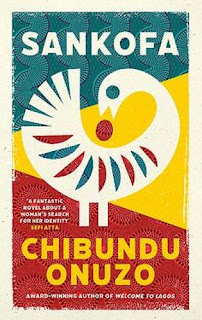
Sankofa by Chibundu Onuzo
Reviewer: Catriona Troth
What We Thought of It:
“You came to meet a man in the past. There is a mythical bird we have here, Anna. We call it Sankofa. It flies forward with its head facing backwards. It’s a poetic image, but it cannot work in real life.”
Clearing out the
house after the death of her mother, Anna comes across a notebook written by the
father she never knew. Written when he was a young African student on the fringes
of radical politics, it reveals a story she was never told – of how her parents
met. Yet it ends abruptly, without explanation as to why he left and never came
back.
With these clues to
go on, she begins to research his name, and discovers to her shock that her
father became the first President of Bamana, the country of his birth. And that
his legacy is anything but straightforward.
She first tracks
down the British academic who wrote his biography and then, with great trepidation,
travels to Bamana to confront her father and learn something about her own
identity. But Anna finds herself an obroni (foreigner) in Bamana, out of
her depth, pulled in different directions, judging the country – and her father
– with European eyes.
Initially
suspicious, her father – still a powerful and wealthy man – makes her a Bamanan
citizen and then takes her to his country home, an estate where he wields enormous
power and where they call him Daasebre: “we cannot thank you enough”.
But other members of
the family are less than happy at the appearance of this previously unknown
eldest daughter from England. And when Anna begins to challenge some of her
father’s actions, things get complicated. Is there a way for Anna to find a
reconciliation between the two parts of herself?
Sankofa is an exploration
of how identity impacts those of African heritage, of the complicated
relationship between Europe and Africa and how it affects them, their values
and their sense of self. Onuzo, like Anna, challenges both European and African
standards and assumptions.
You’ll Enjoy This If
You Loved: When We Speak of Nothing by Olumide Poloola; Admiring Silence by
Abdulrazak Gurnah; The Private Joys of Nnenna Maloney by Okechukwu Nzelu; Brit(ish)
by Afua Hirsch
Avoid If You
Dislike: Fictionalised versions of Africa
Perfect
Accompaniment: A bottle of ice cold water and a sketchpad and paints
Genre: Contemporary,
Literary
Thursday, 10 March 2022
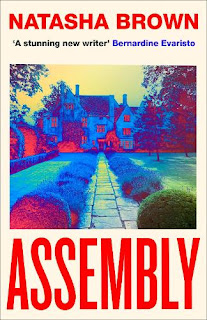
Assembly by Natasha Brown
Reviewer: Catriona Troth
What We Thought of It:
The protagonist of Natasha Brown’s Assembly is, to all outward appearances, a success story. Despite her background, despite the colour of her skin, she has ‘made it’. She has a good degree from a prestigious university, a well-paid high-flying job, a relationship with the kind of man who gives her entrée into British society. She is invited to give talks to young women in schools, to inspire them:
The diversity must be seen. How many young woman and girls have I lied to? How many have seen my grinning face advocating for this or that firm, or this industry, or that university, this life?
But what no one else knows is that she has just received a cancer diagnosis. A cancer that will, without treatment, inevitably kill her. A treatment that she has decided to refuse.
Through the weave of the narrative, the cancer becomes a metaphor for racism, her refusal of treatment a refusal of complicity. A refusal to accept ‘diversity’ and ‘tokenism’ as a sticking plaster in place of rooting out racism and inequality.
Surviving makes me a participant in their narrative. Succeed or fail, my existence only reinforces this construct. I reject it. I reject these options. I reject this life. Yes, I understand the pain. The pain is transformational – transcendent – the undoing of construction. A return, mercifully, to dust.
Brown takes aim at the smug liberality that congratulates itself for the success of a few Black faces while at the same time:
We have seen now, just as then, the readiness of this government and its enterprising Home Secretary to destroy paper, our records and proof. What is citizenship when you’ve watched screaming Go home vans crawl your street? […] When British, reduced to paper, is swept aside and trodden over?
Assembly is short, slim even for a novella. But Brown’s excoriating prose punches well above its slender weight.
You’ll Enjoy This If You Loved: Exquisite Cadavers by Meena Kandasamy; That Reminds Me by Derek Owusu;
Avoid If You Dislike: Fragmented narratives
Perfect Accompaniment: Tea and toast
Genre: Literary Fiction
Buy This Book Here
Tuesday, 8 March 2022
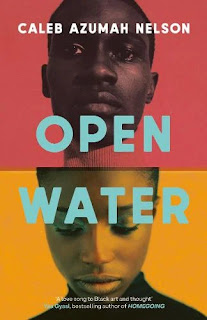
Open Water by Caleb Azumah Nelson
Reviewer: Catriona Troth
What We Thought of It:
Open Water is an astonishing love story – delicate, tender, sensual, intimate.
It is written in the second person – an unknown narrator addressing the male protagonist, a young Black man, throughout as ‘you’. Whoever this narrator is, they are privy to the man’s deepest and most private thoughts and emotions. As readers, we find ourselves at once deep inside the protagonist’s head, and yet at one critical remove from it – a clever, challenging and at times unsettling balancing act.
The man meets the women he falls in love with at a party, when she is still in a relationship with a friend of his. He is a photographer, she a dancer. The connection is immediate and intense, and though neither of them makes a move to act upon it, the electricity between them is enough to fracture her previous relationship.
For a long time, they remain as intimate friends, though the direction of travel of their relationship feels inevitable. Nelson’s descriptions of the slow graceful process of surrendering to love are exquisite:
You’re like a pair of jazz musicians, forever improvising. Or perhaps you are not musicians, but your love manifests in the music. Sometimes, your head tucked into her neck, you can feel her heartbeat thudding like a kick drum. Your smiles a grand piano, the glint in her eye like the twinkle of hands caressing ivory keys.
Yet overshadowing everything is the ugly beat of racism, threatening to warp something inside him.
We are all hurting, you said. We are all trying to love, to breathe, and find ourselves stopped by that which is out of our control. We find ourselves unseen. We find ourselves. Unheard. We find ourselves mislabelled. We who are loud and angry, we who are bold and brash. We who are Black. We find ourselves not saying it how it is. We find ourselves scared. We find ourselves suppressed, you said.
Could this ugliness destroy what is beautiful between them? Even though she knows its poison as well has he does? And if so, is there any way back?
This is prose, but wall between it and poetry is gossamer thin. Each word has been weighed carefully and chosen for its impact on the ear and mind of the reader. You don’t read about this relationship: you live it.
You’ll Enjoy This If You Loved: Who’s Loving You? (ed: Sareeta Domingo); Love after Love by Ingrid Persaud; The Gift of Looking Closely by Al Brookes
Avoid If You Dislike: Second Person Narratives
Perfect Accompaniment: 'Brenda' by Isaiah Rashad
Genre: Literary Fiction, Romance
Buy This Book Here